
A Home for Every First-Year Student: New Tower Rises at the Heart of Campus
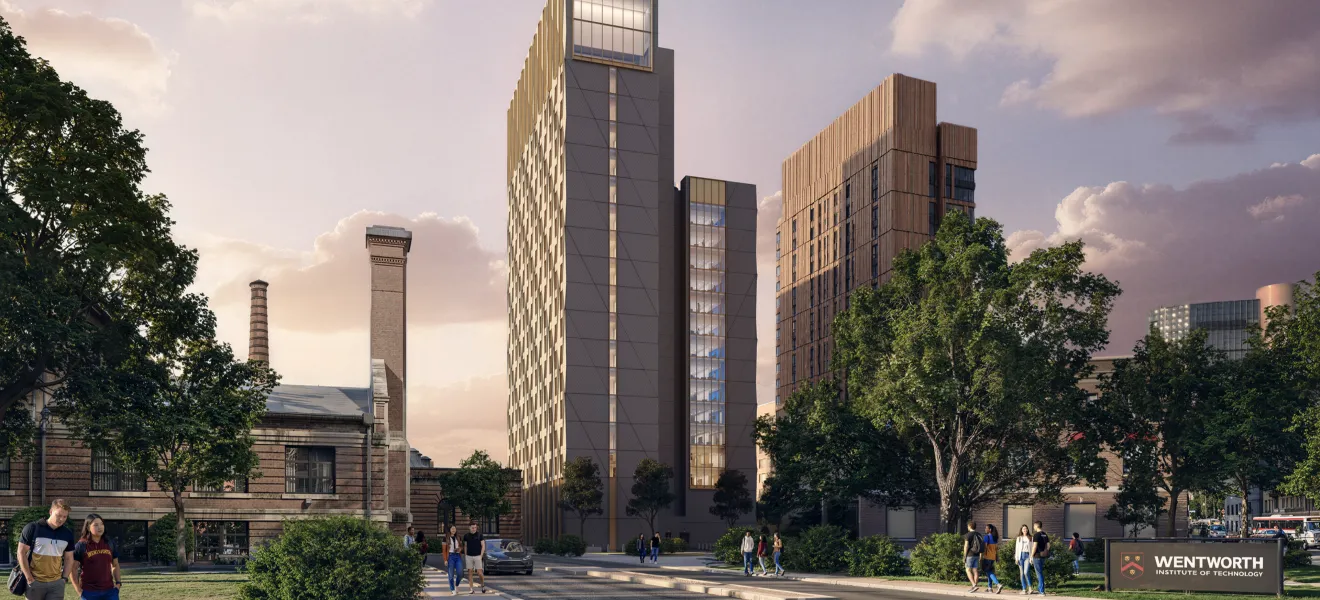
The First-Year Tower Residence Hall will house 972 students and bring Wentworth's entire first-year residential class together under one roof. (Rendering by Perkins&Will)
For decades, the West Parking Lot was the kind of place you moved through on your way to somewhere else. By the fall of 2028, it will be the place where every Wentworth Institute of Technology student's journey begins.
Construction is now underway on the First-Year Tower residence hall, an 18-story, 202,000-square-foot residence on Ruggles Street that will house 972 students, enough to bring Wentworth's entire first-year residential class together under one roof for the first time in the university's history. The $200 million development, financed through a bond secured from MassDevelopment in July, is the largest building project Wentworth has ever undertaken.
It is also one of the first buildings of its kind in Massachusetts: an all-electric residence hall designed to meet Passive House standards, among the most rigorous energy-efficiency benchmarks in the world.
But ask the people behind the project what they're building, and the conversation rarely starts with square footage.
"The First-Year Tower is the clearest expression yet of the university we're becoming," said President Mark A. Thompson. "Our first-year students are not just getting a place to live. They'll be joining a community built intentionally around their success, academically, socially, and personally. This building represents Wentworth's commitment to every student from their very first day."
A vision years in the making
The idea didn't arrive overnight. In 2019, Thompson wrote to the campus community about exploring a new residence hall (at the time, a 200-student building envisioned for the corner of Huntington Avenue and Ward Street). Even then, the goals were the same ones driving the project today. Thompson aims to improve the student experience, modernize aging residence halls, house more students on campus, and ease pressure on the surrounding neighborhood's housing market.
Seven years later, that early exploration has grown into something far more ambitious. The First-Year Tower is the centerpiece of Wentworth's 10-year Institutional Master Plan, announced in 2024, which calls for roughly 1,400 new beds across new and reimagined residence halls. Within the next decade, the university aims to house approximately 75 percent of its students on campus.
Built around the first year
What makes the First-Year Tower different from a traditional residence hall is who it's for, and how deliberately it's been designed for them.
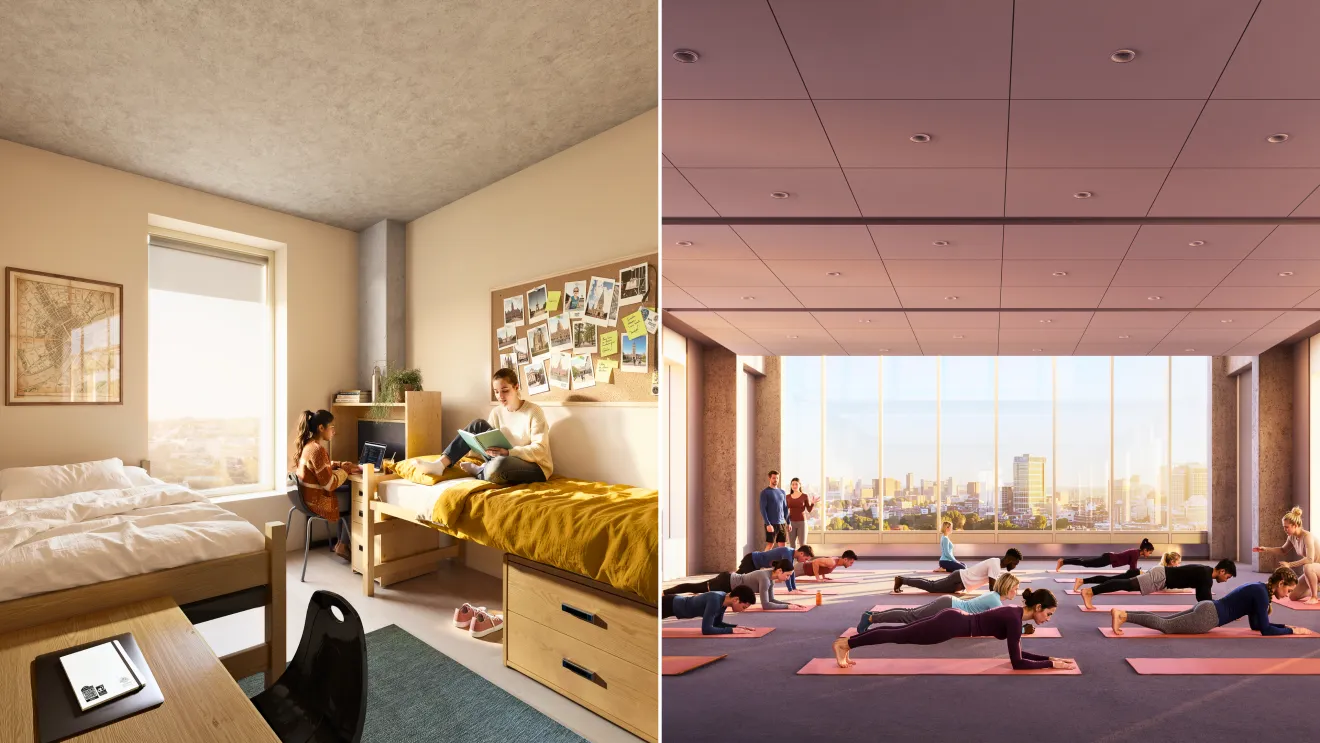
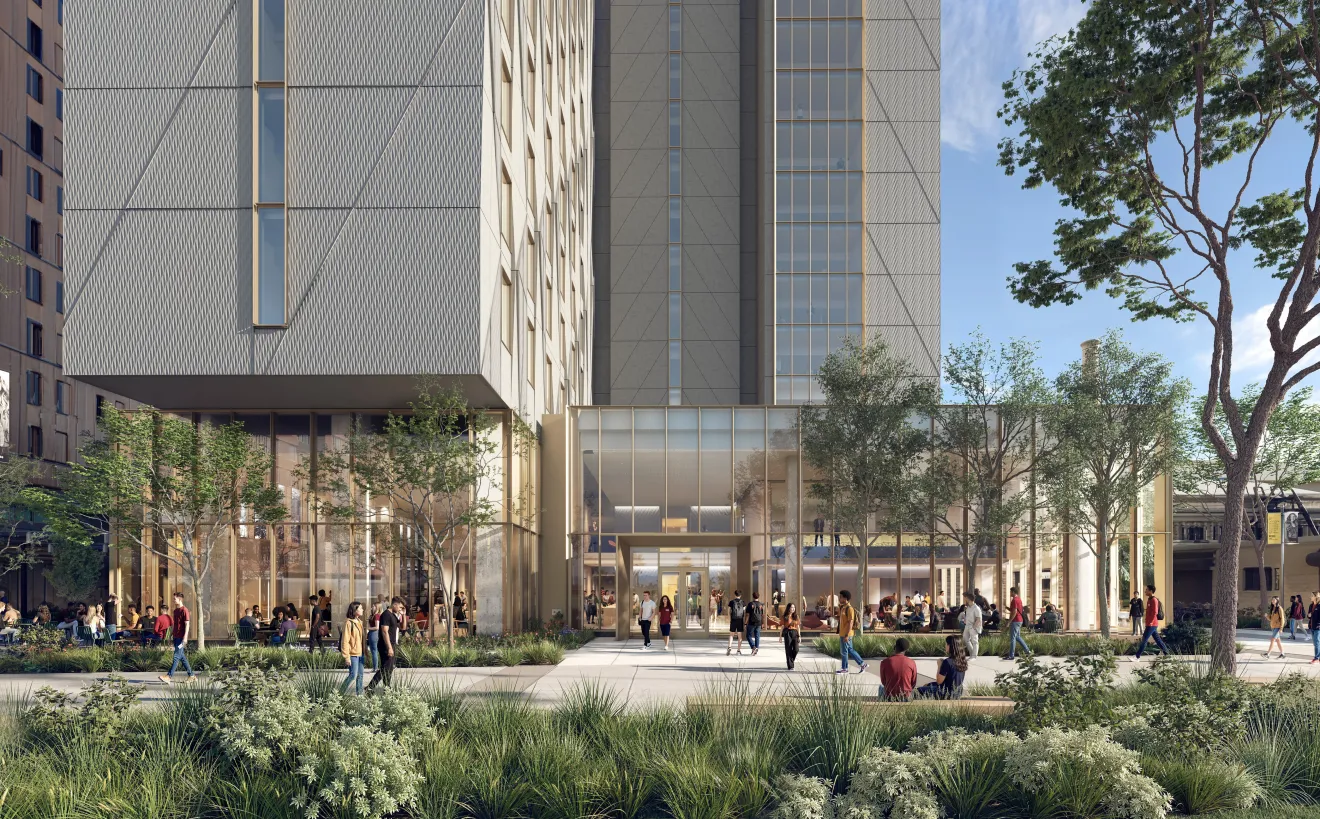
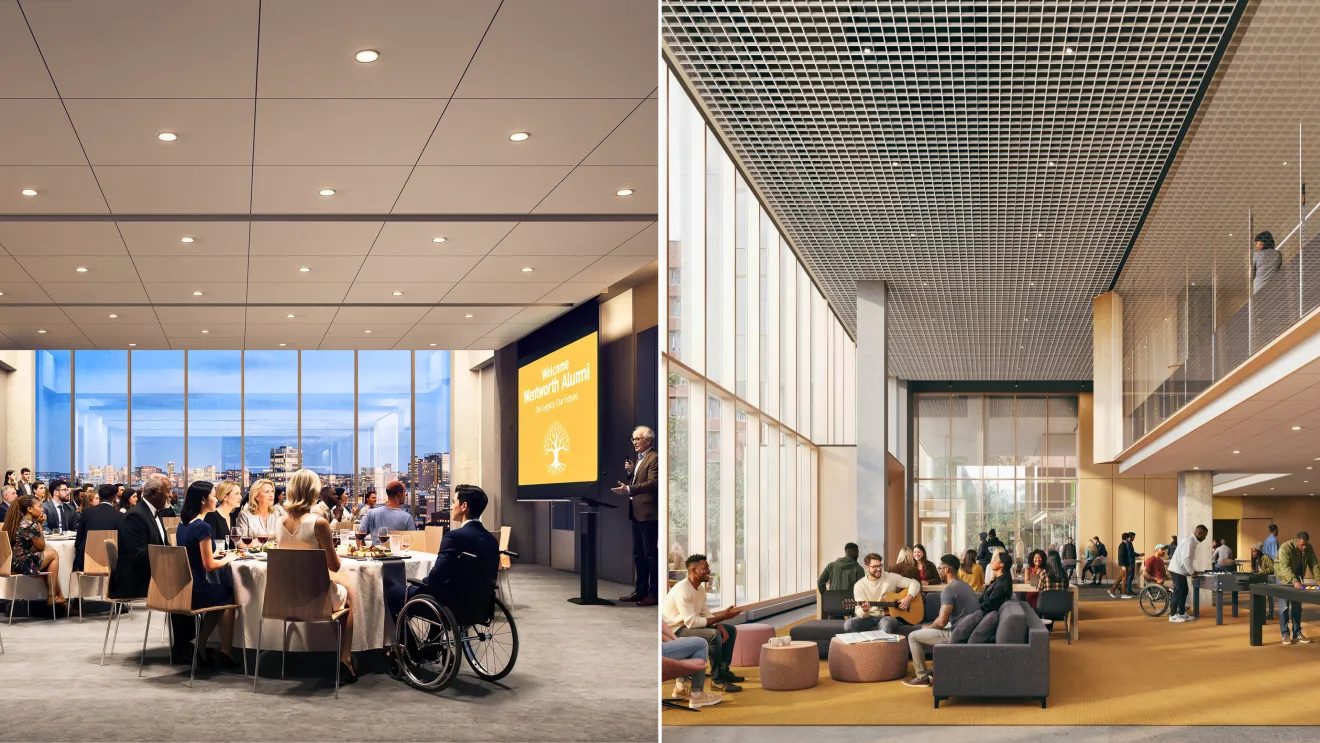
With a ground level that opens outward to the campus, the lower floors include dining options, lounge space, and gathering areas meant to serve residents as well as the broader Wentworth community and its neighbors. The residential floors above offer four uniquely tailored, centralized lounges to help nearly a thousand first-year students build meaningful connections.
“When an entire first-year class lives together, it creates opportunities that simply aren't possible when students are spread across multiple buildings,” said Courtney McKenna, Vice President for Student Affairs. “It allows us to intentionally design the first-year experience, from orientation and living-learning communities to the everyday moments that help students find their community. College is a lot easier when you know people, feel connected, and have a place where you belong. That's the kind of experience we're building with the First-Year Tower.”
Designed for the future
For the Tower’s residents, the high-performance Passive House design will be something they can feel. The design shapes nearly every element of the building from a high-performance envelope that dramatically cuts the energy needed for heating and cooling to continuously filtered air in a quieter, more comfortable interior. And because the facility is fully electrified, no fossil fuels will be burned on site, a meaningful commitment in a city working to decarbonize its building stock.
The same choices that shrink the building's environmental footprint also protect the university's bottom line for years to come.
“We're not just thinking about what it costs to build today, we're also thinking about what it costs to run this building for decades," said Matt Gruber, Senior Vice President of Finance and Administration. "Going all-electric lets us control our energy costs, but it's also the right way to build now. Our students care deeply about the environmental impact, and many of them will spend their careers designing and constructing sustainable buildings. They should get to live in one that practices what we teach."
A different kind of project
The First-Year Tower is also being delivered differently than any building in Wentworth's history. The project is being developed in partnership with Balfour Beatty Campus Solutions and BR+A Consulting Engineers, with Perkins&Will as architect and BOND managing construction, a partnership model that allowed the university to move from design to groundbreaking at a pace few campus projects achieve.
"Our partnership with Wentworth has been particularly meaningful as we've worked to reinvent the first-year residential experience on campus," said Amy Aponte, senior vice president at Balfour Beatty Campus Solutions.
Aponte noted that bringing the building from design to development in less than a year required immense dedication, praising the university's transparency and willingness to work alongside developers to navigate a highly aggressive schedule.
"Wentworth students are special. The level of personal responsibility they take in their educational success is inspiring," Aponte said. "With their input, we hope to have shaped a community that encourages their curiosity, supports their well-being, and facilitates their connection with one another and the greater Boston community."
That speed never came at the expense of intention. Every design decision traces back to the students who will live there.
"The First-Year Tower is a transformational project for Wentworth," said Vital Albuquerque, Senior Project Manager and Senior Associate at Perkins&Will, the project's architect. "We designed a place that helps students connect and build community at their own pace. It's a building that is uniquely Wentworth: bold, purposeful, and crafted with the same care and rigor its students bring to their own work."
A living classroom
To date, 48 Wentworth alumni have worked on the project, and current students on co-op are directly involved alongside the professional teams bringing the tower out of the ground. For the next two years, faculty, staff, and students across Wentworth's programs (including Construction Management, Engineering, and Architecture) will have a front-row view of a major urban building project unfolding in real time, in the middle of their own campus.
"This might be the most Wentworth thing about the whole project," said Joe Dacey, Senior Vice President for Strategy, Planning, and Enrollment. "Many of our former and current students are helping to build something for future students. And our faculty are using the site as a living classroom. The tower will serve students for generations, but it's teaching them already."
Building community beyond campus
The First-Year Tower also marks a new chapter in Wentworth's relationship with the city. The project follows a landmark payment-in-lieu-of-taxes agreement between Wentworth and the City of Boston (the first such agreement between the two in 20 years) that pairs the university's growth with community benefits.
By housing more students on campus, the tower eases pressure on the rental market in Mission Hill, Roxbury, and the Fenway. The project additionally includes a new access corridor to Ruggles Street, an extension of the pedestrian pathway known as the Pike, and new bikeshare stations supported by a university contribution to the Boston Transportation Department.
What comes next
Site work is already visible at the heart of campus, and the pace will pick up through the fall as foundation work continues. The university community will gather to mark the milestone at the groundbreaking ceremony on Thursday, September 17, with the First-Year Tower scheduled to welcome its first residents in August 2028.
Regular construction and project updates are being shared on the project website.