


Your Pathway to High-Impact Aerospace Careers
Designed to meet modern industry demand, Wentworth’s Aerospace Engineering degree prepares you for high-impact, lucrative careers in one of the nation's top engineering hubs.
-
Is Aerospace Engineering Right for You?
If you have a deep curiosity about aircraft, satellites, space exploration, or complex engineering systems you belong here. Our Aerospace Engineering program is designed for inquisitive, driven students who want to solve challenging problems and turn engineering principles into real-world technology. At Wentworth, students are involved in hands-on projects from day one.
Hands-on Industry-Driven Learning
Built from the ground up to align with modern industry needs, our interdisciplinary curriculum prepares graduates for high-demand aerospace careers.
Here, learning extends far beyond lectures. You will build deep conceptual understanding and 21st-century technical skills through:
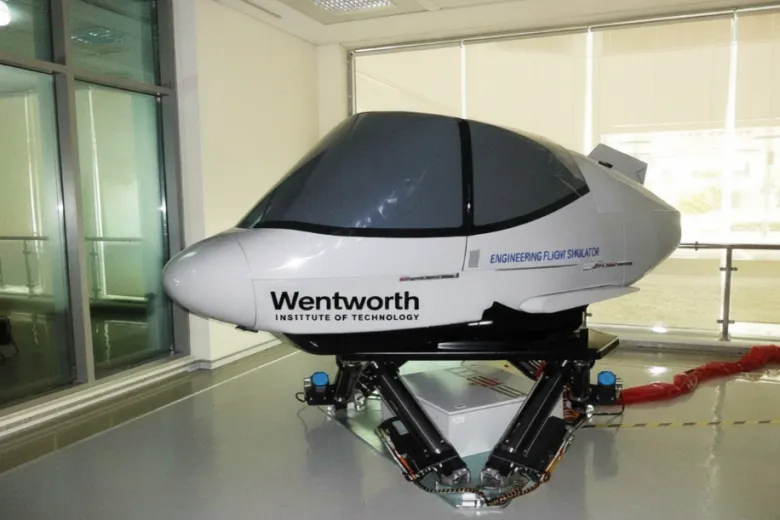
- Advanced Flight Simulation: Design, model, and evaluate air vehicles using desktop cockpit simulators.
- Project-Based Labs: Experience transformative learning by designing, building, and testing complex aerospace hardware and software.
- Workforce-Focused Skills: Master the exact tools, programming languages, and problem-solving methodologies top employers look for.
The Aerospace Outlook
Aerospace Engineering is a rapidly growing field driven by the expansion of the private aerospace industry and increasing demand for innovative air and space technologies. According to the World Economic Forum, advancements in aerospace engineering are helping drive the rapidly growing global space economy, which is projected to reach $1.8 trillion by 2035.
Take the Next Step
Ready to design the future of flight and space? Explore the Curriculum and Career Outcomes tabs to view detailed course and career paths.
-
High-Impact Career Pathways
As technological innovation rapidly expands across commercial aviation, national defense, and space exploration, the demand for highly skilled aerospace engineers continues to accelerate. Positioned in the heart of New England's tech hub, Wentworth’s Aerospace Engineering program equips you with the exact technical tools, simulation experience, and systems-level thinking top employers seek.
Market Demand & Earning Potential
- Job Growth: The U.S. Bureau of Labor Statistics projects employment for aerospace engineers to grow 6% through 2034, faster than the average for all occupations, generating roughly 4,500 new job openings each year due to industry expansion and workforce retirements.
- Competitive Pay: Graduates enter a thriving engineering market. Aerospace engineers in the Greater Boston area earn a median annual wage of $106,664 (Lightcast Analyst), making it one of the region’s most lucrative undergraduate engineering disciplines.
Where Your Degree Can Take You
An Aerospace Engineering degree offers a versatile, rigorous foundation that opens doors across commercial, defense, government, and private space sectors. Career pathways include:
- Aerospace Engineer
- Aircraft Systems Engineer
- Space Systems Engineer
- Avionics Engineer
- Aerospace Systems Analyst
- Flight Test Engineer
- R&D Specialist in aerospace applications
-
The Bachelor of Science in Aerospace Engineering program is a 4-year innovative degree for students who wish to enter the field ready to address real-world challenges in the design, development, and testing of aircraft, spacecraft, satellites, and rockets.
View the Course Catalog below for information about program requirements. For an overview of the year-by-year experience in the Bachelor of Science in Engineering program, see "What You'll Learn" below.
Plan of Study Grid First Year Fall Semester Credits ENGR1000 INTRODUCTION TO ENGINEERING 3 MATH1776 CALCULUS 1A 2 MATH1777 CALCULUS 1B 2 English Sequence 4 PHYS1250 ENGINEERING PHYSICS I 4 FYS1000 FIRST YEAR SEMINAR 1 Credits 16 Spring Semester ENGR1300 FIRST-YEAR ENGINEERING DESIGN 2 ENGR1406 APPLIED ENGINEERING ANALYSIS-BSEN 2 MATH1876 CALCULUS 2A 2 MATH1877 CALCULUS 2B 2 English Sequence* 4 PHYS1750 ENGINEERING PHYSICS II 4 Credits 16 Second Year Fall Semester MATH2600 DIFFERENTIAL EQUATIONS & LINEAR SYSTEMS 4 CHEM1100 GENERAL CHEMISTRY I 4 ENGR2100 PROGRAMMING FOR ENGINEERS 4 MECH2400 APPLIED MECHANICS 4 Credits 16 Spring Semester MATH2025 MULTIVARIABLE CALCULUS 4 MECH2270 THERMODYNAMICS 4 MECH2275 THERMODYNAMICS LAB 1 Social Science Elective 4 MECH2300 ENGINEERING GRAPHICS 3 COOP2500 INTRODUCTION TO COOPERATIVE EDUCATION 0 Credits 16 Summer Semester COOP3000OPTIONAL COOP EDUCATION Credits 0 Third Year Fall Semester MATH2100 PROBABILITY & STATISTICS FOR ENGINEERS 4 MECH3100 ENGINEERING FLUID MECHANICS 4 MECH3550 AEROSPACE MATERIALS 4 AERO3100 - AIRCRAFT STRUCTURES New Course 4 Credits 16 Spring Semester COOP3500 COOP EDUCATION 1 0 Credits 0 Summer Semester MECH3850 ENGINEERING DYNAMICS 4 AERO3550 AERODYNAMICS New Course 4 AERO3500 AEROSPACE PROPULSION New Course 4 AERO3600 FLIGHT MECHANICS & CONTROL New Course 4 Credits 16 Fourth Year Fall Semester COOP4500 COOP EDUCATION 2 0 Credits 0 Spring Semester ENGR5000 ENGINEERING SENIOR DESIGN I 4 Free Elective 4 Humanities Elective 4 AERO4050 ORBITAL MECHANICS New Course 4 Credits 16 Summer Semester ENGR5500 ENGINEERING SENIOR DESIGN II 4 AERO4600 ATTITUDE DETERMINATION AND CONTROL New Course 4 HSS Elective 4 Free Elective 4 Credits 16 Total Credits 128 ENGL/HSS Note
Students are required to complete:
- At least one course in Humanities: CSAS, HSSI, HIST, HUMN, LITR and PHIL
- At least one course in the Social Sciences: CSAS, HSSI, COMM, ECON, ENVM, POLS, PSYC and SOCL
- The remaining course from either the Humanities or Social Sciences category.
Students with a three English course sequence may use the third English course to satisfy a Humanities requirement.
A minimum of 20 credits total, including English, humanities, and social science credit, is required to complete the humanities and social sciences graduation requirement.
Math Placement may alter the course schedule above.
What You'll Learn
-
Year 1
You’ll establish a foundation for your Aerospace Engineering program by taking introductory courses in physics and calculus, along with Introduction to Engineering, which will instill core engineering concepts that you’ll use throughout the program. You’ll also dive into engineering courses that utilize essential tools like CAD.
-
Year 2
Second-year students begin to take courses in Programming, Thermodynamics, Engineering Graphics, and Applied Mechanics.
An optional pre co-op work term is available to students during the summer semester.
-
Year 3
In the fall and summer semesters of your third year, you’ll continue to bolster your engineering knowledge in courses like Aerospace Materials, Aircraft Structures, Aerospace Propulsion, and Aerodynamics.
In the spring, you’ll begin the first of two required co-ops.
-
Year 4
In the fall, you’ll go on your second required co-op to gain more hands-on industry experience.
The remainder of your program includes your Engineering Senior Design for your capstone project, which you’ll work on over your final two semesters.