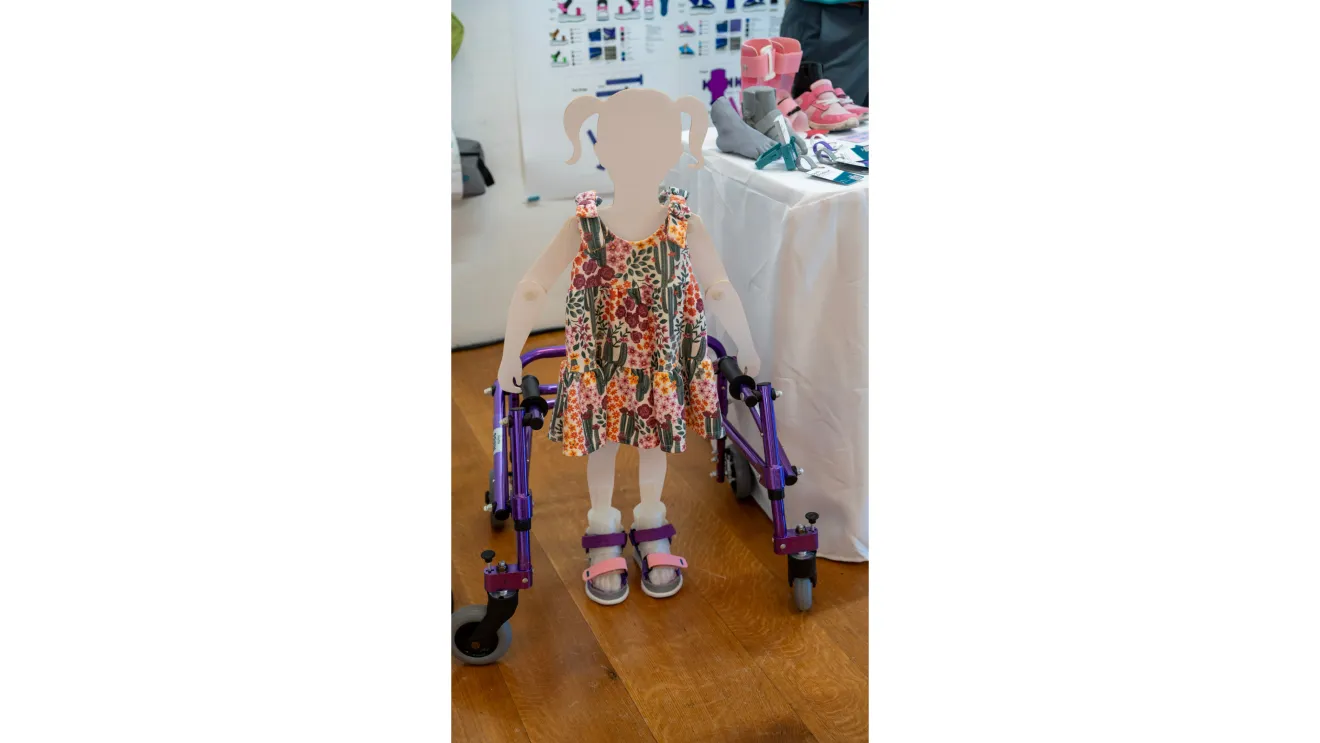
For His Daughter, a Wentworth Student Designs a Better Shoe for Leg Braces
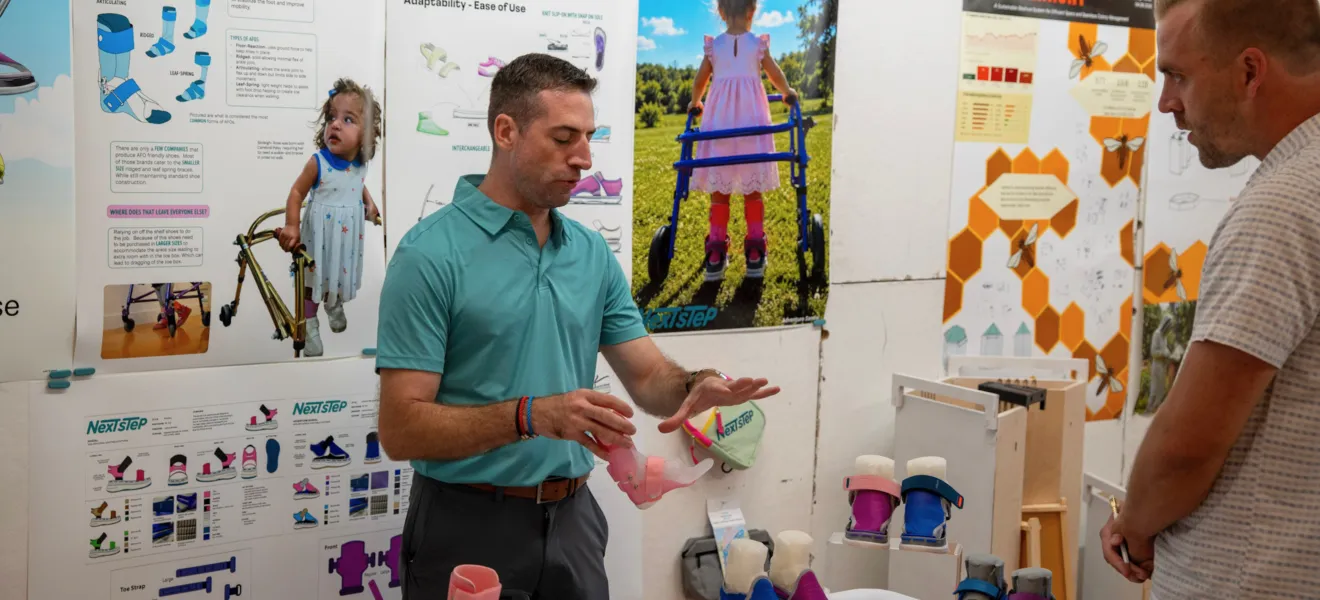
Joshua Broddeur explains his NexStep shoe prototype during the Industrial Design Student Showcase event
Finding properly fitting shoes for children who require leg braces is a persistent challenge. For Wentworth Institute of Technology Industrial Design senior Joshua Brodeur, it was a daily hurdle for his 3-year-old daughter with cerebral palsy.
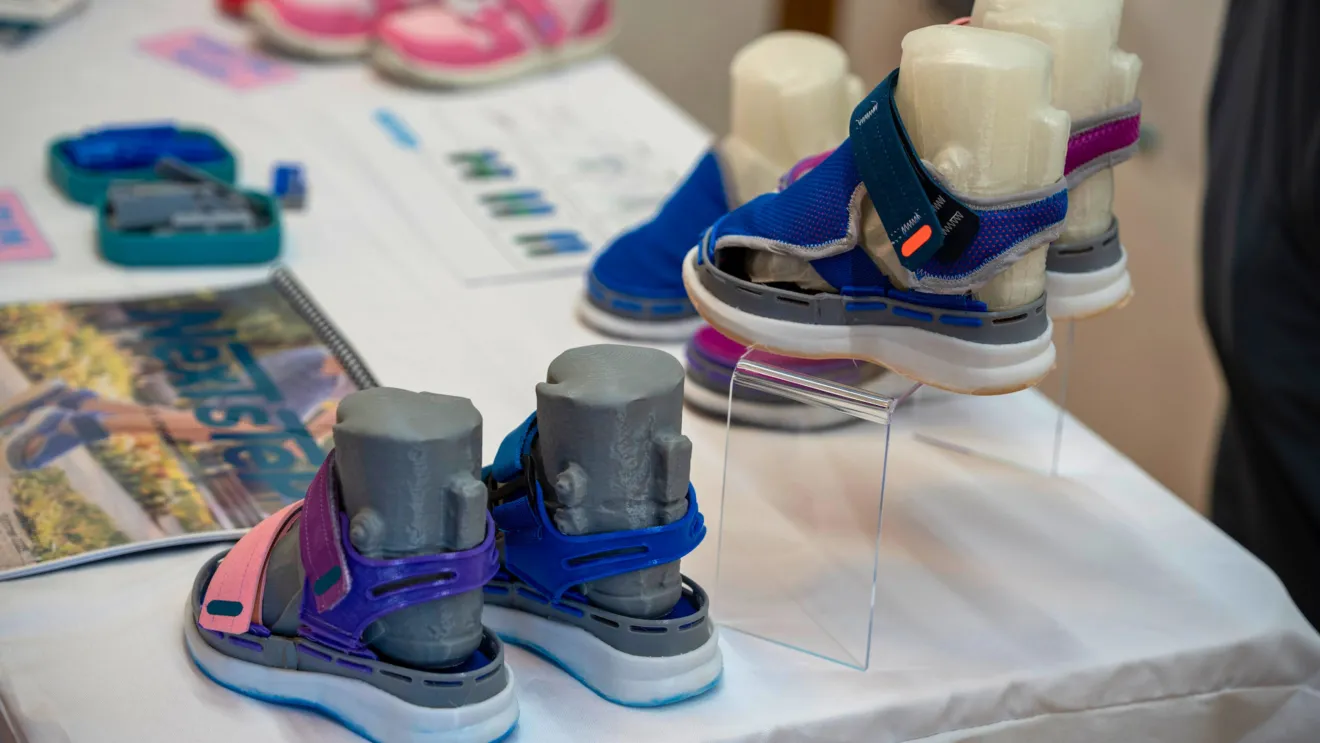
Driven by this personal connection, Brodeur spent two semesters designing NexStep, an adaptive footwear system designed to accommodate ankle-foot orthoses (AFOs) while providing children with style options. He recently showcased his working prototypes in Watson Auditorium, demonstrating a practical solution to the common problem of forcing standard sneakers over bulky medical braces.
Brodeur came to Wentworth after two decades in the U.S. Coast Guard. He enlisted in 2000 at 18, worked in engineering, search and rescue, and law enforcement, and retired in 2021 before enrolling at Wentworth. Outside the classroom, he is a film photographer and model maker.
Brodeur’s goal for NexStep was “to create a shoe that could be worn by both children with AFOs and children without.”
“The shoes that are out there currently are mostly mainstream shoes, so they’re not the greatest of fit, especially with the braces,” Brodeur said. “A lot of shoe companies just aren’t able to produce a shoe specifically for the brace.”
AFOs typically extend from just below the knee to the foot to stabilize the ankle and improve mobility. Because they come in different shapes and designs, standard sneakers often don’t fit comfortably over them.
Brodeur approached the problem by rethinking how footwear is constructed. Instead of creating a single shoe that has to accommodate every type of brace, he designed NexStep as a modular system. The sole serves as a common base, while the upper can be detached and replaced with different styles and sizes.
“I came up with a whole system where the upper part of the shoe is able to be detached from the sole, allowing for different styles of shoes, and also for different fits,” Brodeur said. “You could go with, if you had to, a larger size upper to be able to fit certain size braces.”
The same sole can also accommodate new styles as a child’s needs change, and because only the upper has to be swapped, the design reflects Brodeur’s interest in sustainable, practical products.
“It not only just works for children with cerebral palsy, but it also could be able to work for children that don’t have cerebral palsy,” he said. “Any child could actually wear these shoes.”
His most important product tester is his daughter.
“She loves them,” Brodeur said. “Every time I come home from school and I work on my project, she’d ask me, ‘Hey Daddy, are you working on my shoes?’”