


-
The Wentworth Computer Science program teaches students technical skills that will help shape the modern world. The program builds upon foundational knowledge by exposing students to real-world problems and challenging them to innovate to find the best solutions. By forging this practical knowledge, our graduates are well-prepared to dive into today's workforce.
Pursue Your Preferred Focus Area
Students can select advanced elective courses in topics like mobile application development, web development, artificial intelligence, embedded computing, biostatistics, and machine learning. Our graduates are prepared to work as software engineers, programmers, and analysts across standard, web, and mobile device platforms.
Co-op Experience with Top Employers
Through Wentworth’s strong network of employers, including many alumni, Computer Science students obtain professional experience during their two required cooperative work semesters. Partners hiring our co-op students include Adobe Systems, Alliant, Brigham and Women's Hospital, The Department of Defense, DraftKings, IBM, Liberty Mutual, Salesforce, Walt Disney World, and Wayfair.
-
The Wentworth Bachelor of Science in Computer Science program is accredited by the Computing Accreditation Commission of ABET.
For program objectives, outcomes and enrollment and degree data, please visit the Computer Science Accreditation Information page.
-
Wentworth Computer Science graduates obtain well-paying jobs in a range of fields. Median starting salary of a Computer Science major is $76,000.
Recent graduates find jobs at top companies in Boston and around the country. The Top 5 employers of the most recent class of Wentworth Computer Science graduates are:
- Boston Properties
- Wayfair
- Harvard University
- enLabel Global Services, Inc.
Average hourly co-op pay for Computer Science majors is $23.76.
Find a more in-depth look at career outcomes below.
-
Students in the Bachelor of Science in Computer Science program gain valuable skills in software design, programming languages, systems, and development in high-level computer languages. Related courses including databases, software engineering, networking, and operating systems are also integral in this program. Elective courses are available in a wide variety of computing areas including web development, mobile development, embedded computing, artificial intelligence, machine learning, and cybersecurity. Students also apply these skills directly in the work environment through two required co-op work semesters beginning junior year.
View the Course Catalog below for information about program requirements.
For an overview of the year-by-year experience in the Bachelor of Science in Computer Science program, see "What You'll Learn" below.
Catalog
On This PageFour Year Program
Total credits for degree: 121
This is a four-year full-time program, starting in the fall semester of the student’s first year and planned to end in the summer semester of the student’s fourth year. The courses are as follows:
Plan of Study Grid First Year Fall Semester Credits COMP1000 COMPUTER SCIENCE I 4 MATH1776 CALCULUS 1A 2 MATH1777 CALCULUS 1B 2 MATH2300 DISCRETE MATHEMATICS 4 English Sequence* 4 FYS1000 FIRST YEAR SEMINAR 1 Credits 17 Spring Semester COMP1050 COMPUTER SCIENCE II 4 COMP1200 COMPUTER ORGANIZATION 4 MATH1876 CALCULUS 2A 2 MATH1877 CALCULUS 2B 2 English Sequence* 4 Credits 16 Second Year Fall Semester COMP2000 DATA STRUCTURES 4 COMP2100 NETWORK PROGRAMMING 4 MATH2860 LINEAR ALGEBRA & MATRIX THEORY 4 HSS Elective* 4 Credits 16 Spring Semester COMP2350 ALGORITHMS 4 COMP2650 DATABASE MANAGEMENT SYSTEMS 4 MATH2100 PROBABILITY & STATISTICS FOR ENGINEERS 4 FREE Elective 4 COOP2500 INTRODUCTION TO COOPERATIVE EDUCATION 0 Credits 16 Summer Semester Co-op Semester C Prerequisite(s): Prerequisite(s): COOP2500 and COMP2350Credits 0 Third Year Fall Semester COMP3400 OPERATING SYSTEMS 4 Computer Science Elective 1 4 SCIENCE Elective 2 4 HSS Elective* 4 Credits 16 Spring Semester Co-op Semester C Prerequisite(s): Prerequisite(s): COOP2500 and COMP2350Credits 0 Summer Semester COMP3350 PROGRAMMING LANGUAGES 4 COMP3450 PARALLEL COMPUTING AND DISTRIBUTED COMPUTING 4 FREE Elective 4 SCIENCE Elective 2 4 Credits 16 Fourth Year Fall Semester Co-op Semester C Prerequisite(s): Prerequisite(s): COOP2500 and COMP2350Credits 0 Spring Semester COMP4960 SOFTWARE ENGINEERING 4 Computer Science Elective 1 4 HSS Elective * 4 Credits 12 Summer Semester COMP5500 SENIOR PROJECT 4 Computer Science Elective 1 4 FREE Elective 4 Credits 12 Total Credits 121 - 1
Computer Science students take a total of three computer science electives. Students must select three courses from the list of Computer Science Electives. The Computer Science Elective courses to be offered in a particular semester will be selected by the School of Computing and Data Science.
- 2
BCOS students must take two lab-based science electives selected from the list of approved science courses.
ENGL/HSS Note
Students are required to complete:
- At least one course in Humanities: CSAS, HSSI, HIST, HUMN, LITR and PHIL
- At least one course in the Social Sciences: CSAS, HSSI, COMM, ECON, ENVM, POLS, PSYC and SOCL
- The remaining course from either the Humanities or Social Sciences category.
Students with a three English course sequence may use the third English course to satisfy a Humanities requirement.
A minimum of 20 credits total, including English, humanities, and social science credit, is required to complete the humanities and social sciences graduation requirement.
At least one of the HSS electives must be an Ethics course selected from the following list.
Course List Course Title Credits COMM4300 MEDIA ETHICS 4 CSAS1000 INTRODUCTION TO COMPUTER SCIENCE + SOCIETY 4 CSAS2000 COMPUTER SCIENCE + SOCIETY STUDIO 4 PHIL4401 ENGINEERING ETHICS 4 PHIL4501 ETHICS 4 PHIL4525 A.I. ETHICS 4 PHIL4550 BIOETHICS 4 PHIL4600 DESIGNING THE GOOD LIFE 4 PHIL4700 ENVIRONMENTAL ETHICS 4 Math Placement may alter the course schedule above.
Computer Science Electives, select three (3) courses from the following list:
The Computer Science Elective courses may include, but are not limited to:
Course List Course Title Credits All non-required 2000+ courses from AAIN, COMP, CYBR, DATA COMP1150 ROUTING AND SWITCHING 4 MATH4050 MACHINE LEARNING 4 Science Electives, select two (2) courses from the following list:
Course List Course Title Credits BIOL1000 GENERAL BIOLOGY 4 BIOL3000 APPLICATIONS IN GENETICS 4 CHEM1100 GENERAL CHEMISTRY I 4 CHEM1600 GENERAL CHEMISTRY II 4 PHYS1250 ENGINEERING PHYSICS I 4 PHYS1750 ENGINEERING PHYSICS II 4 PHYS2000 INTRODUCTION TO ASTRONOMY 4 PHYS3100 MODERN PHYSICS 4 The following courses require School approval to satisfy the Science Elective requirement BIOL2990 INDEPENDENT STUDY IN BIOLOGY 4 BIOL3800 SPECIAL TOPICS IN BIOLOGY 4 CHEM2990 INDEPENDENT STUDY IN CHEMISTRY 4 CHEM3800 SPECIAL TOPICS IN CHEMISTRY 4 PHYS2990 INDEPENDENT STUDY IN PHYSICS 4 PHYS3800 SPECIAL TOPICS IN PHYSICS 4 and
FREE Electives: Select any three 4 credit courses.
CA minimum of two required co-op education courses (COOP3500 and COOP4500) must be completed. COOP5000 can also be taken as an additional optional co-op experience.
Three Year Program
Total credits for degree: 121
This is a three-year full-time accelerated program, starting in the fall semester of the student’s first year and planned to end in the summer semester of the student’s third year. The courses are as follows:
Plan of Study Grid First Year Fall Semester Credits COMP1000 COMPUTER SCIENCE I 4 MATH1776 CALCULUS 1A 2 MATH1777 CALCULUS 1B 2 MATH2300 DISCRETE MATHEMATICS 4 Science Elective 2 4 English Sequence* 4 Credits 20 Spring Semester COMP1050 COMPUTER SCIENCE II 4 COMP1200 COMPUTER ORGANIZATION 4 MATH1876 CALCULUS 2A 2 MATH1877 CALCULUS 2B 2 Science Elective 2 4 English Sequence* 4 Credits 20 Second Year Fall Semester COMP2000 DATA STRUCTURES 4 COMP2100 NETWORK PROGRAMMING 4 COMP2650 DATABASE MANAGEMENT SYSTEMS 4 MATH2860 LINEAR ALGEBRA & MATRIX THEORY 4 HSS Elective* 4 COOP2500 INTRODUCTION TO COOPERATIVE EDUCATION 0 Credits 20 Spring Semester COMP2350 ALGORITHMS 4 COMP3400 OPERATING SYSTEMS 4 Computer Science Elective 1 4 MATH2100 PROBABILITY & STATISTICS FOR ENGINEERS 4 HSS Elective* 4 Credits 20 Summer Semester Co-op Semester C Prerequisite(s): Prerequisite(s): COOP2500 and COMP2350Credits 0 Third Year Fall Semester COMP3350 PROGRAMMING LANGUAGES 4 COMP4960 SOFTWARE ENGINEERING 4 Computer Science Elective 1 4 FREE Elective 4 FREE Elective 4 Credits 20 Spring Semester Co-op Semester C Prerequisite(s): Prerequisite(s): COOP2500 and COMP2350Credits 0 Summer Semester COMP3450 PARALLEL COMPUTING AND DISTRIBUTED COMPUTING 4 COMP5500 SENIOR PROJECT 4 Computer Science Elective 1 4 HSS Elective* 1 4 FREE Elective 4 Credits 20 Total Credits 120 - 1
Computer Science students take a total of three computer science electives. Students must select three courses from the list of Computer Science Electives. The Computer Science Elective courses to be offered in a particular semester will be selected by the School of Computing and Data Science.
- 2
BCOS students must take two lab-based science electives selected from the list of approved science courses.
ENGL/HSS Note
Students are required to complete:
- At least one course in Humanities: CSAS, HSSI, HIST, HUMN, LITR and PHIL
- At least one course in the Social Sciences: CSAS, HSSI, COMM, ECON, ENVM, POLS, PSYC and SOCL
- The remaining course from either the Humanities or Social Sciences category.
Students with a three English course sequence may use the third English course to satisfy a Humanities requirement.
A minimum of 20 credits total, including English, humanities, and social science credit, is required to complete the humanities and social sciences graduation requirement.
At least one of the HSS electives must be an Ethics course selected from the following list.
Course List Course Title Credits COMM4300 MEDIA ETHICS 4 CSAS1000 INTRODUCTION TO COMPUTER SCIENCE + SOCIETY 4 CSAS2000 COMPUTER SCIENCE + SOCIETY STUDIO 4 PHIL4501 ETHICS 4 PHIL4525 A.I. ETHICS 4 PHIL4550 BIOETHICS 4 PHIL4600 DESIGNING THE GOOD LIFE 4 PHIL4700 ENVIRONMENTAL ETHICS 4 Math Placement may alter the course schedule above.
Computer Science Electives, select three courses from the following list:
The Computer Science Elective courses may include, but are not limited to:
Course List Course Title Credits All non-required 2000+ courses from AAIN, COMP, CYBR, DATA COMP1150 ROUTING AND SWITCHING 4 MATH4050 MACHINE LEARNING 4 Science Electives, select two courses from the following list:
Course List Course Title Credits BIOL1000 GENERAL BIOLOGY 4 BIOL3000 APPLICATIONS IN GENETICS 4 CHEM1100 GENERAL CHEMISTRY I 4 CHEM1600 GENERAL CHEMISTRY II 4 PHYS1250 ENGINEERING PHYSICS I 4 PHYS1750 ENGINEERING PHYSICS II 4 PHYS2000 INTRODUCTION TO ASTRONOMY 4 PHYS3100 MODERN PHYSICS 4 The following courses require School approval to satisfy the Science Elective requirement BIOL2990 INDEPENDENT STUDY IN BIOLOGY 4 BIOL3800 SPECIAL TOPICS IN BIOLOGY 4 CHEM2990 INDEPENDENT STUDY IN CHEMISTRY 4 CHEM3800 SPECIAL TOPICS IN CHEMISTRY 4 PHYS2990 INDEPENDENT STUDY IN PHYSICS 4 PHYS3800 SPECIAL TOPICS IN PHYSICS 4 and
Free Electives: Select any three 4 credit courses.
CA minimum of two required co-op education courses (COOP3500 and COOP4500) must be completed. COOP5000 can also be taken as an additional optional co-op experience.
-
Interested in getting your M.S. in Applied Computer Science in only one year (two semesters) beyond graduation? Apply to the Double Leopard program as an enrolled undergraduate and fast-track your graduate education and career!
- Available to both 3-year and 4-year undergraduate students
- Carry over Merit Scholarships
- Optional master's internships available
Note: GPA maintenance through all 4 years is required to continue to the graduate program
Student Testimonials
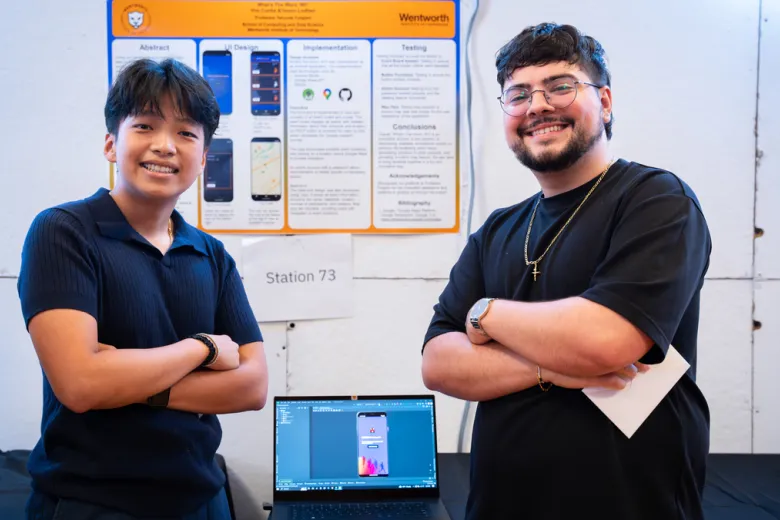
Tenzin Lodhen and Vini Cunha
For our capstone, we created an app called What's the Word Wentworth. The main idea of it is to get students out and about through posting events. The app allows you to create events they can post publicly for pickup games of basketball or getting a group together to do a play. It has RSVP features and a map, so that individual students can post events in addition to campus organizations.

Jillian Desmond
"The biggest challenge I hear recent graduates having to overcome is not having experience. As a Wentworth student, I don't have to worry about that. Every Wentworth graduate has completed 2 semesters of co-op (with an optional third!), which means about 8 months of experience in the work field. I did my two co-ops at different companies so I made twice as many connections and both companies have expressed interest in hiring me after I graduate!"

Sarah Denis
"My favorite thing about being a Wentworth student is the amount of accessibility I have. Whatever I want to pursue there is always someone there willing to help or that can lead me in the correct direction."
What You’ll Learn
-
Year 1
You’ll establish a foundation for your Computer Science program by taking Computer Science I & II, Calculus I & II, and Discrete Mathematics. These courses will lay the groundwork for a comprehensive understanding of practical comp sci concepts.
-
Year 2
Second-year computer science students expand their knowledge with courses in Networking Programming, Data Structures, Algorithms, and Databases. You’ll bolster this knowledge with additional math courses in Probability & Statistics and Linear Algebra.
An optional pre co-op work term is available to students during the summer semester.
-
Year 3
In the fall and summer semesters of your third year, you’ll start to focus on Operating Systems and Programming Languages and will have the opportunity supplement your core program courses with electives in your desired area of study.
In the spring, you’ll begin the first of two required co-ops.
-
Year 4
In the fall, you’ll go on your second required co-op to gain more hands-on industry experience.
The remainder of your program allows you to round out your comp sci knowledge through electives, as well as work on Software Engineering, and on your senior project in your final semester.