
This Wentworth Grad Is Teaching Hasbro's Beloved Characters to Behave in the Age of AI
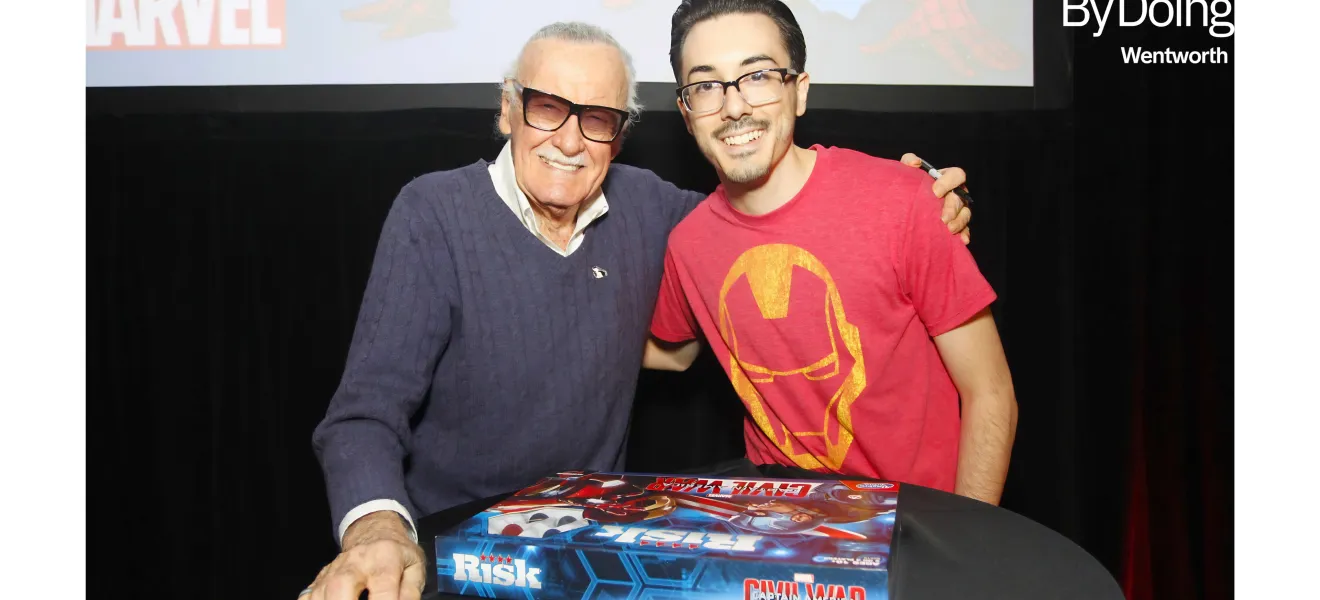
Joe Bradford (right) with Marvel legend Stan Lee
They are the builders, the thinkers, and the problem-solvers. In the "Defined by Doing" series, we highlight exceptional alumni who are translating their education into action and redefining what is possible in their fields. From recent graduates to seasoned industry leaders, these stories prove that the Wentworth community is making a meaningful impact at every stage of the journey.
His day-to-day looks like this: A murder mystery. A Get Out of Jail Free card. A slew of superheroes ready to save the world.
“The thing I love most about my job is it’s centered around play, and there are very few things in life that I think are as enriching and freeing as the act of play,” said Wentworth Institute of Technology alumnus Joe Bradford. “It’s such a safe way to learn and socialize and experience a different side of the people that you love.”
Bradford, who graduated from Wentworth in 2012 with a degree in Industrial Design, works as a principal AI product designer at Hasbro. He’s also the co-founder of the company’s newly launched AI studio called Sixth Wall, which regulates the usage and application of the brand’s identifiable faces and likenesses in the growing realm of AI.
“Hasbro is one of the largest holders of many beloved brands and characters, and in the age of AI, people are creating their own versions of those like Optimus Prime and Peppa Pig that can now hear, think, speak, see, act, and do, as AI agents,” Bradford explained. “But when they’re doing that, they’re off brand. They’re not safe for kids oftentimes, and they’re also not paying out the voice talent that is behind the character.”
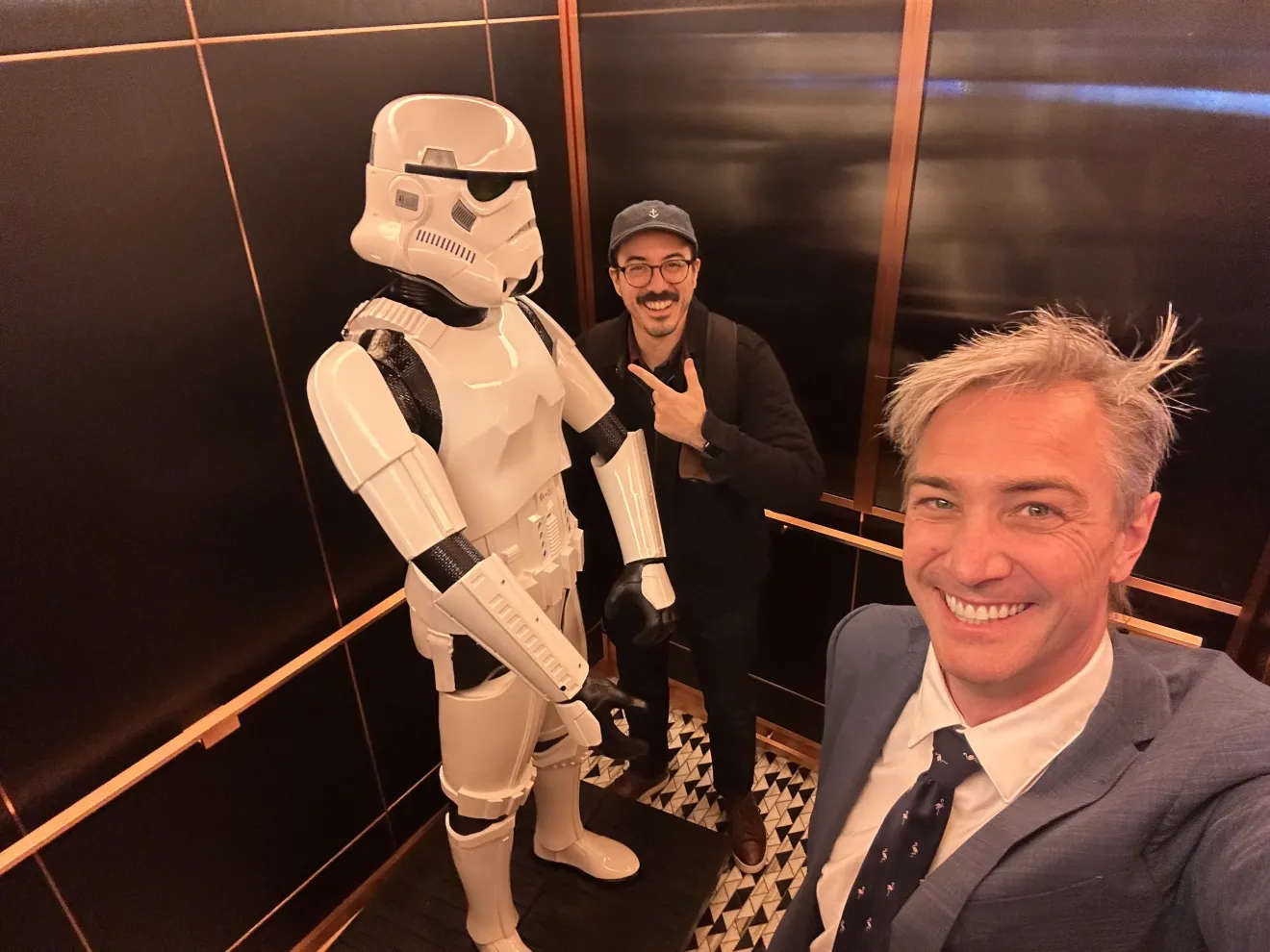
Initially established in January 2024, Sixth Wall has adopted the mission of safeguarding exchanges with these characters while exploring the innovation’s capacities.
“We’re taking an approach to building this technology in a first-party way, to feature versions of these characters that kind of have the ‘authorized blue checkmark’ you see on social media,” Bradford said.
Having previously worked in Hasbro’s entertainment licensing and family games sectors, and as the former design manager for Monopoly, Bradford said the new studio emerged after he and his colleagues began dabbling with AI advancements.
“In 2023, when ChatGPT 3.5 came out, we started to play around with it. I had recently wrapped up a game called Monopoly Knockout, which combines the game mechanics of shuffleboard with the semiotics of Monopoly,” Bradford recalled. “And in one chat session, ChatGPT was able to take these two divergent concepts and map them together in a way that was essentially what I had concepted for a month. I went to my boss and said, ‘This is game changing.’”
Eager to explore the potential advantages of generative AI, Bradford formed an internal group within Hasbro to conduct and evaluate experiments that went live on the company’s website.
“The first one we did was Ouija, where users could pretend to ‘talk to spirits’ through AI, and the other was with Trivial Pursuit,” Bradford said. “On National Trivia Day, we launched Trivial Pursuit Infinite, which was a web experience based on the prototype that we had pulled together. It ended up amplifying the sales of the physical game, and we saw about a 30-percent lift on physical products just because there was a new way to play Trivial Pursuit.”
The impressive outcome caught the attention of Hasbro’s CEO, and by October 2025, Sixth Wall had officially become its own studio at the company. Bradford was employee No. 2.
“We knew we needed to build a team that was dedicated to generative AI experiences because it was clear that there was more there than just these two experiments,” he said.
Previously, Bradford’s first endeavor at Hasbro, working on the GI Joe team, came about when he was a junior at Wentworth and participated in the university’s co-op program.
“That was a really interesting opportunity because, at the time, the sequel to the GI Joe movie was being made. And I got to see how the world of entertainment and product licensing weaved together in a unique way,” Bradford reflected. “I would go and read through the script and put mood boards together to help inspire the production of the film, which was just super cool to participate in as an intern.”
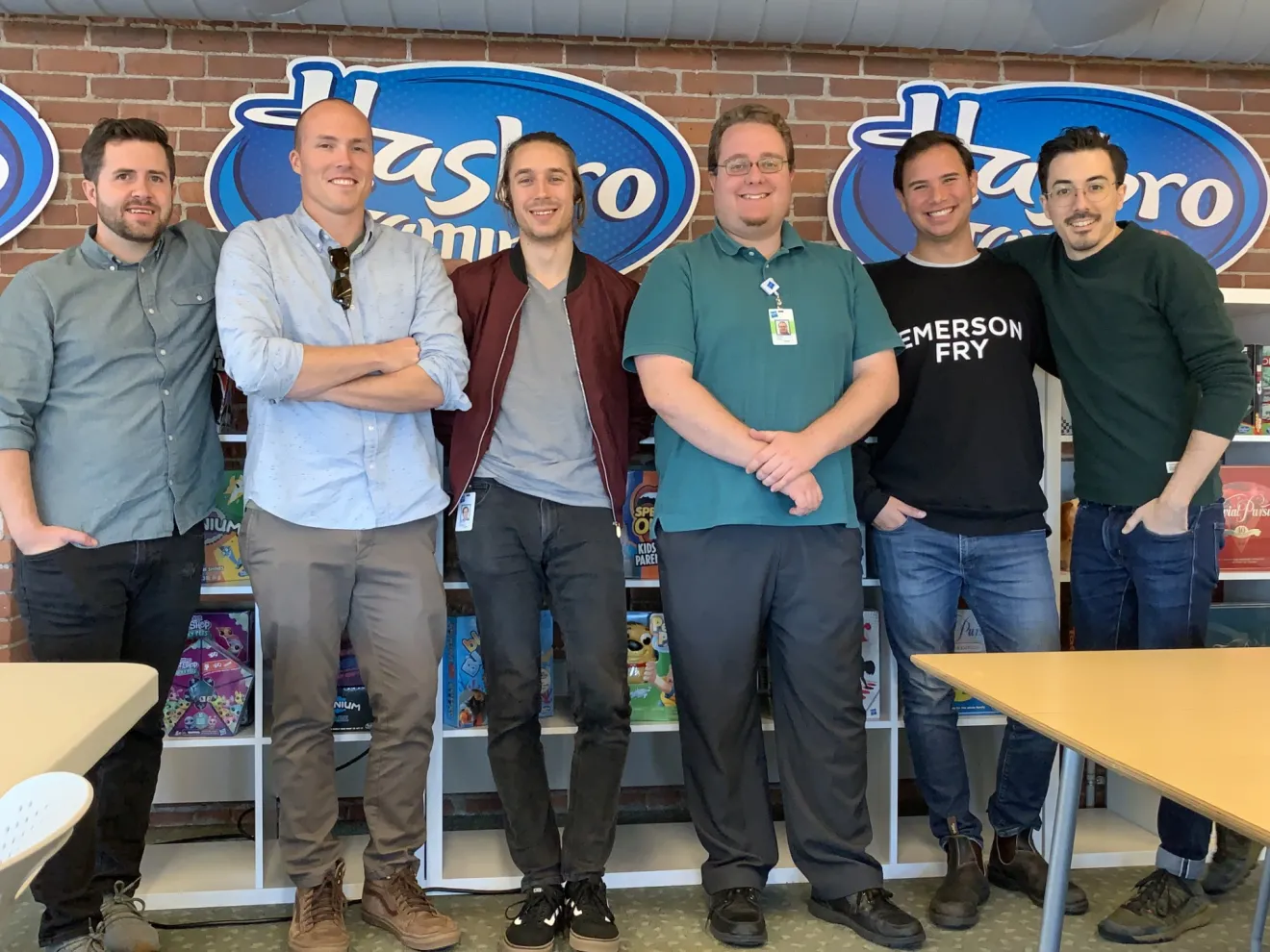
After graduation, Bradford was invited back to Hasbro for a temporary position on the Games team, where he creatively put his industrial design expertise to use.
“For me, that experience was another place where entertainment and product were colliding,” he said. “I was working on licensed product, and we would work very closely with Disney and Lucasfilm to create board games based off of the new Star Wars movies or the Marvel and Avengers movies.”
Employing the skills he garnered at Wentworth, Bradford then went on to lead the Family Games team at Hasbro and helped relaunch the Clue franchise.
“In the process of creating a board game, you’re not only designing the physical product, which my industrial design background was imperative for, but the game that happens between all the components is really like a design system,” he said. “It’s an organizational information system that needs to be understood by new players instantly.”
Bradford said his education continues to be instrumental in supporting his career success.
“The design thinking methodology that was instilled in me during my time at Wentworth was totally formative in how I approached learning how to do the work. It provided, at every step of the way, a framework that I could go back to,” he said. “Whenever I’ve been in the design-thinking phase, or prototyping, testing, and iterating on game concepts, that methodology I learned at Wentworth really informed all of it.”
With gratitude for his past opportunities at the university, Bradford remains inspired by the ever-evolving gaming atmosphere of the future, which, he noted, most certainly includes AI.
“Play is one of the ways that we can learn about how this technology works and embrace it in a way that gives people agency in how they interact with it,” Bradford said. “I think that a key insight is that it’s never a replacement for; it’s always an addition to. People will always be playing games face to face, but there’s a new medium in which people can experience playful interactions safely. And that’s exciting.”