
Wentworth Breaks Ground on First-Year Tower
Photos by John Gillooly
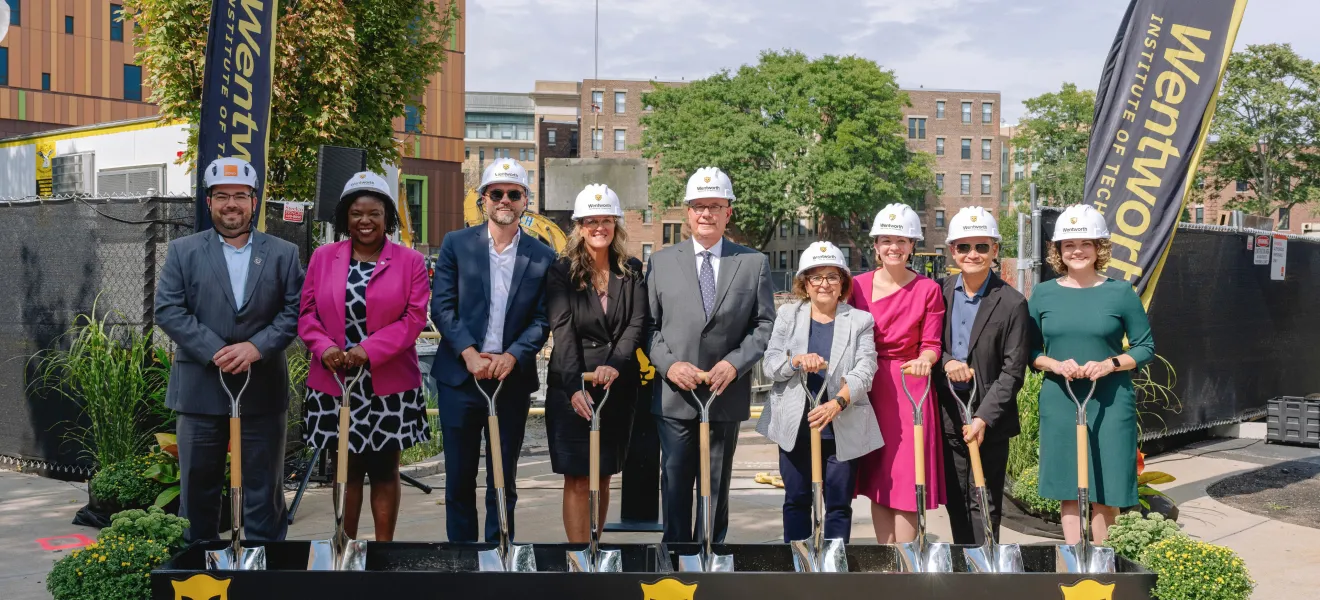
The First-Year Tower does not exist yet, but it was everywhere Thursday afternoon. Renderings of the 18-story residence hall stood around a tent on the Wentworth Quad, offering a glimpse of the building that will rise beside Beatty Hall. Beneath strings of lights and alongside colorful flower arrangements, roughly 250 people gathered to break ground, some in suits and others in orange construction vests and work boots.
When it opens in 2028, the First-Year Tower will house 972 students and bring Wentworth Institute of Technology’s entire first-year residential class together. At 240,000 square feet, built to Passive House standards and fully electric, the tower will be one of the first residential buildings of its kind in Massachusetts.
"For the first time in the 122-year history of this university, our entire first-year residential class will live together under one roof," President Mark A. Thompson said. Most of the students who will live there are in high school today, he noted, adding that "my optimism for the quality of the student experience we will offer them has never been stronger."
Thompson said the decision to dedicate the building to first-year students was deliberate.
"The first year sets everything in motion," he said. "Everything that follows, from co-ops to capstones to earning a degree, grows out of what happens in that first year."
Courtney McKenna, vice president for Student Affairs, told the crowd that what excites her about the project is not the building itself.
"What excites me most about this building is what's possible because of it," she said.
She asked the audience to remember what it feels like to arrive at college for the first time, learning a new campus and meeting new people while carrying a set of much larger questions.
"Where do I fit here? Who can I ask for help? What will my Wentworth experience actually look like?" she said. "And, maybe most importantly during those first few weeks: Who will I eat dinner with tonight?"
For many students, McKenna said, those answers have emerged over time and too often by accident.
"Belonging cannot be something we leave to chance,” she said.
Joe Guerrera, a junior studying Computer Science and president of the Wentworth Student Government, made a similar point by telling the crowd how it had gone for him.
"I actually met my best friend at freshman orientation," he said. "We didn't know each other at all when we first met, and I obviously had no idea that we'd end up living together, let alone become best friends. But that random meeting ended up becoming one of the most important relationships I made at Wentworth."
He named one of the greatest benefits of the new building.
"This tower puts every first-year student in the same place, and it takes a lot of that luck out of the equation,” he said.
McKenna also laid out what a building designed around that first year could make possible.
"Imagine orientation traditions that allow students to help shape the physical building and its visual displays, year after year," she said. "Imagine living-learning communities that bring students together around shared interests and experiences, with faculty and staff connecting with students not only in classrooms, studios, and labs, but in the place they call home. Imagine Community Advisors helping students make connections and creating experiences that turn a residence hall into a home."
"Belonging starts with people," she continued. "People create relationships, and relationships are what students carry with them."
For Wentworth Board of Trustees Chair Rose Conti, the project is bound up with her own history at the university.
Conti first came to Wentworth through the certificate programs in the early 1980s, attending classes at night while working during the day. She earned an associate degree in Building Construction Technology in 1990, then returned two decades later to complete a bachelor's degree in Construction Management. She has spent more than 35 years in the construction business and is the first woman to chair Wentworth's Board of Trustees.
"Every single time, Wentworth found a way to say yes to me with a door that stayed open to a working adult with a family and a job," Conti said. "That is who this university has always been."
She described the board's First-Year Tower decision in direct terms.
"When a board takes on a project of this size, we're not deciding whether a building would be nice to have," she said. "We are deciding what kind of university this is going to be, and then committing to it."
Conti also spoke as someone who has spent a career around job sites.
"There is no better day in my industry than the one when the shovels finally come out," she said. "I've been able to experience a number of those days over the years, but this is one of the best because this time the building belongs to my school."
Boston City Councilor Sharon Durkan, who represents District 8, traced the project back seven years.
"President Thompson shared his vision for a new residence hall," Durkan said. "And today we're breaking ground on that building and making history. And I say 'we' because Wentworth is core to the City of Boston."
Durkan said the university's role in the city extends past ceremonies. "That partnership doesn't stop at this groundbreaking. It's every day."
"This project reflects so much of what makes Wentworth special," she said. "A commitment to building community, a practical and forward-thinking approach to innovation, and a focus on creating opportunities for students to learn and grow at every single turn."
She was joined by At-Large Councilor Ruthzee Louijeune and Boston Chief of Planning Kairos Shen. Thompson also recognized City Councilor Henry Santana, Mayor Michelle Wu's neighborhood liaison Samantha Courage, and Lindsay Butler of the Green Ribbon Commission, along with neighbors in Mission Hill and the Fenway who took part in the Institutional Master Plan process.
"I am grateful to them, and I want to say clearly that they made this a better project," Thompson said.
The project also brings a new access corridor to Ruggles Street, an extension of the Pedestrian Pike, and new bikeshare stations supported by a contribution to the Boston Transportation Department.
Amy Aponte, senior vice president at Balfour Beatty Campus Solutions, said the design began with a diagram and a question.
"What if students stepped off the elevator and landed in their living room?" she said.
A week spent gathering student feedback on the design stood out across three decades of similar work, Aponte said.
"Their level of engagement went beyond curiosity," she said. "They acted as if they were shareholders in the investment. And guess what? They are."
That sense of ownership persists long after graduation, she said, pointing to her own team: 55 Wentworth graduates have worked on the project, including every engineer involved in designing the mechanical, electrical, and plumbing systems.
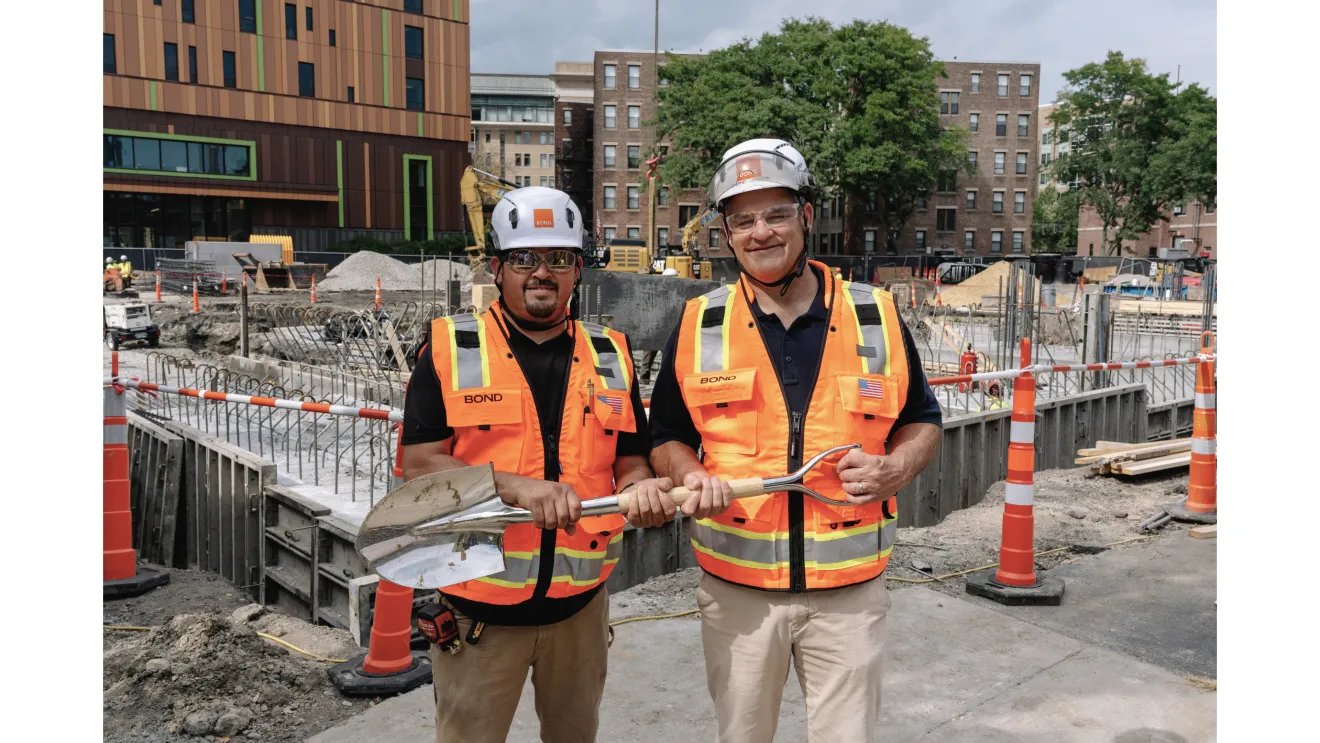
Balfour Beatty Campus Solutions is developing the project with BR+A Consulting Engineers. Perkins&Will is the architect and BOND is managing construction. Financing came through MassDevelopment.
With students passing the site daily for the next two years, Thompson said the project will do double duty.
"At Wentworth, a building like this is never only a building," he said. "It is also a living classroom."
Students on co-op are also working alongside the professional teams now.
"We want them to be the people designing and building them," Thompson said. "This project asks our students to do exactly that and then invites them to live inside the result."
Guerrera drew the same connection from his own field.
"You build things for people you will never meet," he said. "You write something, you hand it off. You just try to make it a little easier for them than it would have been otherwise."
Guerrera then closed with a message for the crews who will be on site through two winters.
"We'll be walking past you every day. We know what you're building," he said. "All of us will become alumni eventually, and it's nice to think that we will leave Wentworth a little better for the students who come next."
McKenna had framed the afternoon in similar terms.
"While we're here to celebrate breaking ground on a new building, I think we're also breaking ground on something much bigger," she said. "A new way of thinking about how students begin their Wentworth experience."