
Wentworth Architecture Studio Brings New Ideas to Historic French City
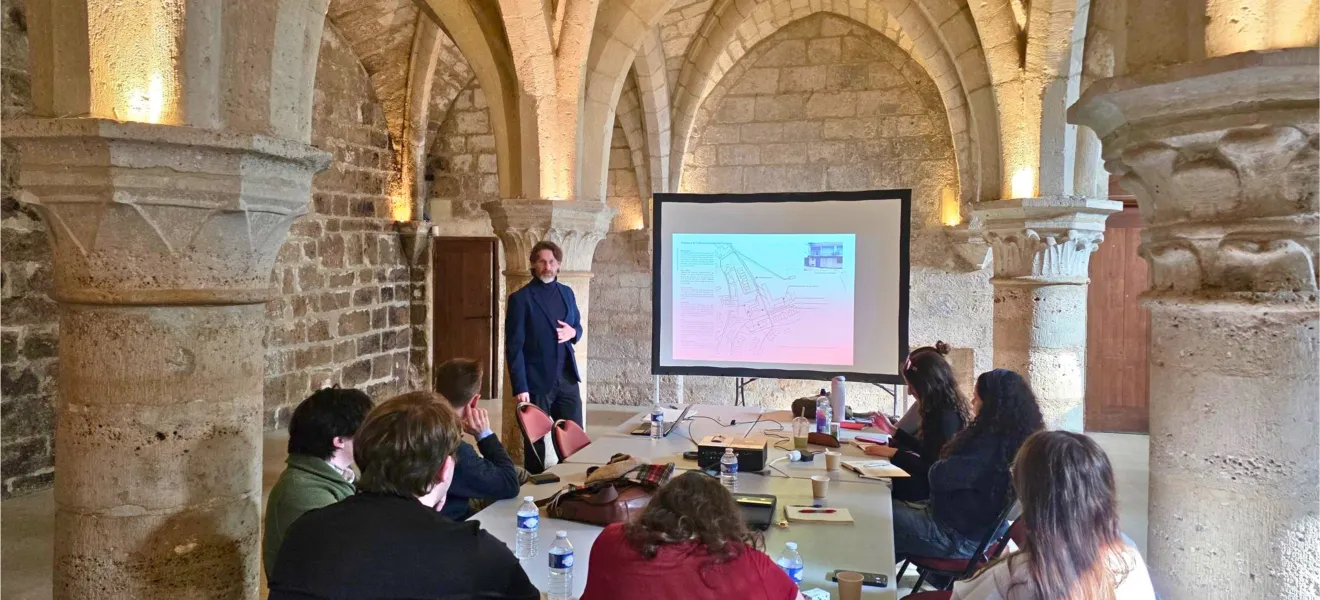
The Laon Municipality provided a convenient working space at La Salle Gothique de la Cathedral, part of the 14th-century Hotel Dieu.
When Professor Anas Soufan set out to find a site for his Spring 2026 Architecture Studio, he went straight to the source, asking officials in the municipality of Laon (a hilltop medieval city in northern France) to suggest locations that could challenge his students.
The site needed historic, urban, and architectural context; it had to be the right size for an academic project; strong views (either across the surrounding valleys and plains, or toward the city’s historic core) were a must; and it had to be connected to a real project the city was considering.
Of the sites proposed, Soufan chose the Saint-Vincent Abbey, located on the southern edge of Laon’s upper town. The studio’s work is published in the book Historicity + Revival through the Haute, Basse and Other Sounds, Laon, which was recently presented to city leaders. Laon’s mayor shared photos of the book’s reception on social media, along with images from his first meeting with Soufan and the studio’s public presentation.
“We were happy, proud, and grateful, because we felt that our work was recognized by the municipality as a valuable contribution to the city’s urban upgrading,” Soufan said.
What pleased him most, he added, was that the students’ proposals brought something new to a long-running local conversation. “I was so delighted to see that our book and projects refreshed the debate about the Saint-Vincent Abbey project with new ideas and concepts that were never discussed by the local authorities,” he said.
Learning from Laon
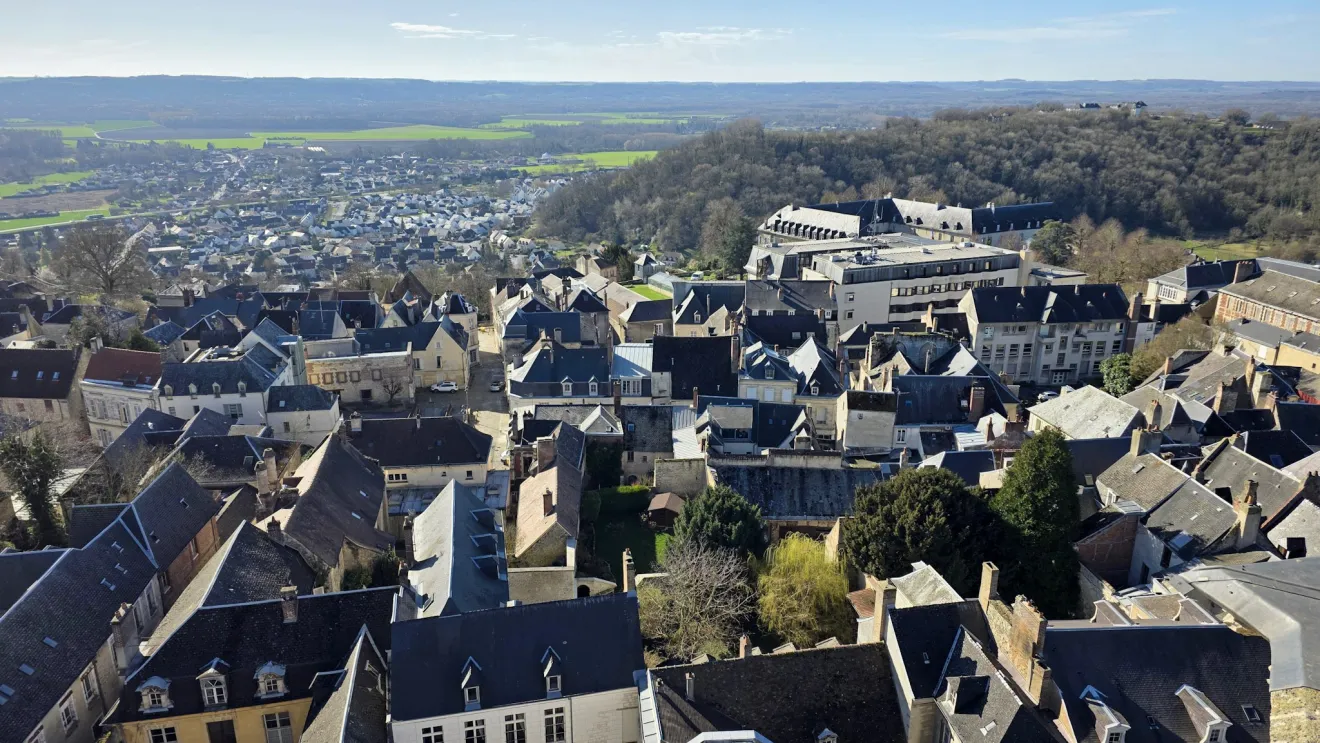
Laon offered very different design challenges for students based in Boston. The French city is split between an upper town, crowned by the Gothic Cathedral of Notre-Dame de Laon, and a lower town spread across a plain. That historic and geographic division was central to the studio work.
Soufan said working in Laon taught students to design within an environment full of medieval buildings and urban fabric while engaging with and learning from a different culture.
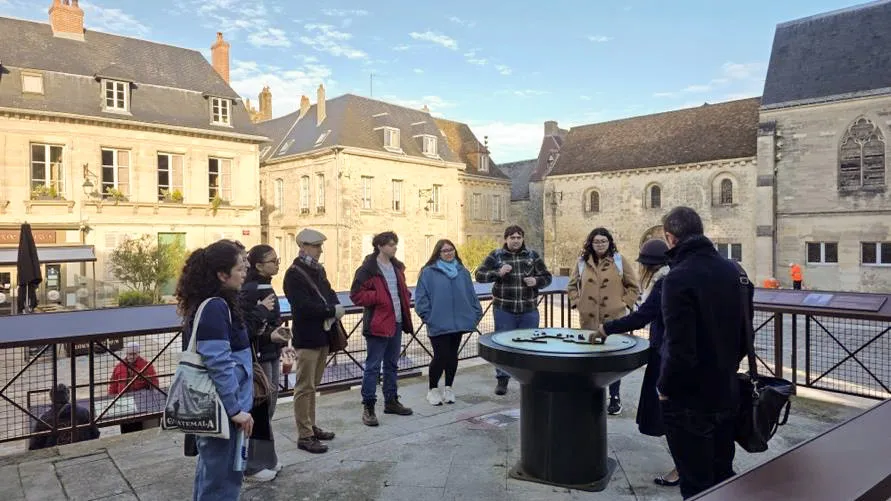
Soufan and eight students from the studio traveled to Laon in March, staying in a house in the upper town that overlooked the abbey site. The municipality provided studio space in the Salle Gothique, a vaulted hall in the city’s 14th-century Hôtel-Dieu. Over the week, students met with Mayor Éric Delhaye, toured the city with a guide provided by the municipality, and spent hours surveying and sketching the site. They also met with a local artist, a musician, and an architect and urban planner who had already worked on the abbey site.
The trip ended with a public presentation. Working in three groups, the students shared their proposals with Delhaye, members of the city council, two of the region’s state heritage architects, the department’s head of cultural affairs, and other local officials and experts. The regional newspaper L’Union covered the event.
One project that captures the studio’s approach is “The Beacon,” by Sam Gately, Architecture ’26. Gately’s design places a slender observation tower at the eastern end of the abbey site, rising above the tree line to offer 360-degree views across the region. The tower is meant to connect the two halves of Laon and draw visitors from across the surrounding Aisne department.
Gately’s design also sets up a visual dialogue with the city’s tallest existing landmark, the towers of the medieval cathedral.
“This project is very meaningful because it proposes an interesting conservation and development approach to the Saint-Vincent site,” Soufan said. The tower would draw attention to the abbey site and give visitors a new way to experience the surrounding landscape, he explained.
“Conservation and development may take place simultaneously,” said Soufan.
Building International Partnerships
Soufan, an architect and heritage management specialist who is also affiliated with Harvard’s Center for Middle Eastern Studies, is working to build on the studio’s momentum. His Spring 2027 studio will focus on the conservation and urban upgrading of the entire Saint-Vincent district, not only the abbey site, and the students’ projects will be shown in an exhibition hosted by the municipality of Laon in July 2027. He recently met in France with leaders from the École Nationale Supérieure d’Architecture Paris-Malaquais, one of the country’s best-known architecture schools, to explore a potential academic collaboration with Wentworth.
Soufan envisions joint studios in which students at both schools work on the same project, either in France or the United States. The partnership could also include exhibitions and workshops, along with eventual student exchanges.
“All our students who have had the opportunity to take study trips to other countries demonstrate distinctive skills in their projects, larger horizons, and deeper critical thinking,” he said.
Soufan’s international work extends beyond France. In Fall 2025, he led a Wentworth studio on the post-war recovery of the Citadel entrance zone in the Ancient City of Aleppo, developed in cooperation with the Aleppo Governorate and Syria’s Directorate General of Antiquities and Museums. The studio was designed to broaden students’ exposure to international challenges in conservation and adaptive reuse.
Soufan will also present at the American Historical Association’s annual meeting in New Orleans in January 2027, where he will discuss the immediate consequences of the fall of the Assad regime for the conservation of Syrian UNESCO World Heritage sites, using the Ancient City of Aleppo as a case study. Before that, on Nov. 16, he will present his work on Aleppo’s post-war recovery through the Global Affairs Program at the Harvard Institute of Politics.