
Physics Graduate Sam Kidd Helps Bring Eclipse into Focus
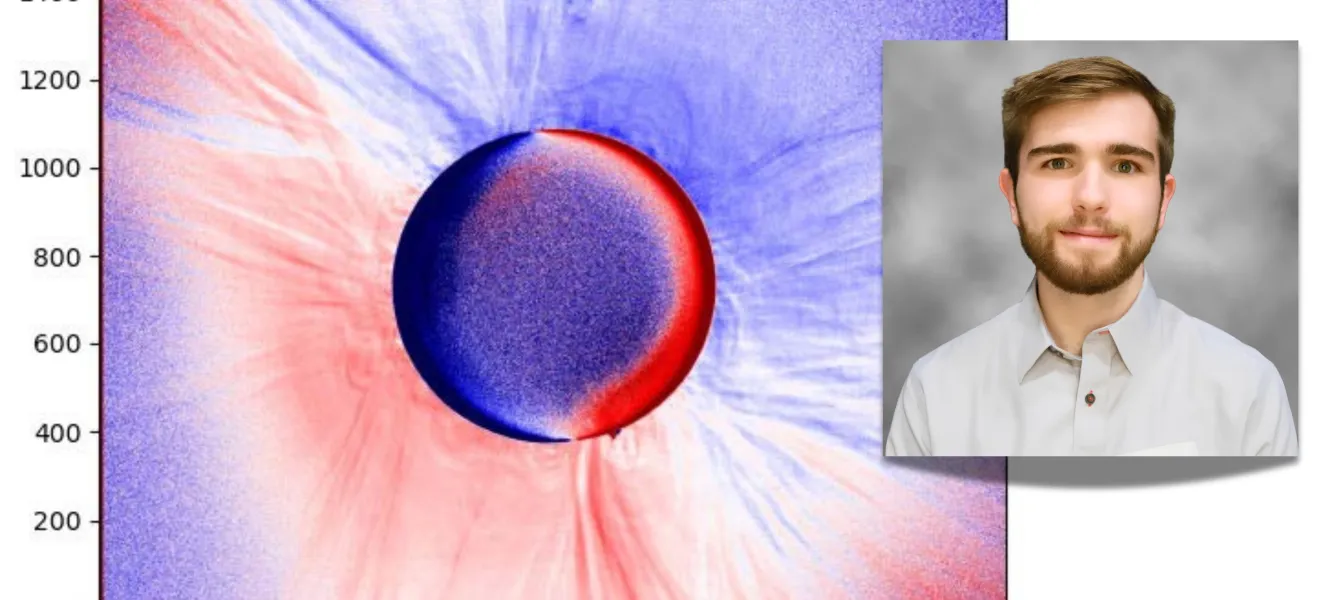
Sam Kidd, the first graduate of Wentworth’s Physics program, built a pipeline to align thousands of eclipse images so researchers can study the Sun’s corona
When the moon passed in front of the sun on April 8, 2024, a chain of telescopes stretching from Texas to Maine was ready to capture it. This past summer, Sam Kidd, the first graduate of Wentworth Institute of Technology's Physics program, helped turn those observations into something scientists can study.
Kidd, who completed his degree in August of this year, spent the summer on a Research Experience for Undergraduates (REU) through the University of Colorado Boulder as part of the Boulder Solar Alliance, a program that places students with research institutions. Kidd was assigned to the Southwest Research Institute (SwRI), where he worked on data from Citizen CATE 2024, a project designed to observe the sun's outer atmosphere, or corona, continuously throughout the eclipse.
Citizen CATE 2024 placed more than 40 telescopes along the path of totality, collecting tens of thousands of images over the roughly hour-long stretch it took the moon's shadow to cross the country.
"The point of eclipse observations is to observe the sun's much dimmer outer atmosphere, which is usually washed out by the sun, but becomes visible during eclipses," Kidd said.
To track changes in the corona, researchers first need to align the sun in every frame. Kidd developed a way to do that even though the moon obscures the sun in the images.
"This is a challenge, as in all of our images the moon is blocking the sun, so the question is how do you align something you can't see?" he asked.
Kidd’s answer was to track the moon instead. Using the known position of each telescope and the time each image was taken, along with the path of the moon's center from frame to frame, Kidd worked out where the sun had to be. From there, he built a data pipeline that aligns the images, saves the corrected data, and produces a smooth movie of the eclipse from a single telescope site.
In a project titled “Co-Aligning 47,000 Images of Totality from Citizen CATE 2024,” Kidd’s method lays the groundwork for aligning images from the other sites and assembling a near-continuous, hour-long view of the corona. The resulting images could help researchers study how the corona changes over time and how its light is polarized. Kidd worked alongside SwRI scientists Will Ashfield, Amir Caspi, and Dan Seaton, and the program was funded by the National Science Foundation.
Kidd's mentors were also involved in a separate project with NASA that uses a WB-57 high-altitude research aircraft to fly in the shadow of an eclipse, extending the observation period. Kidd traveled to Houston to watch test flights and see the camera mounted on the front of the plane.
"The WB-57 was very cool to see. They have a unique design for a plane, and I got to see it take off and land for some quick test flights," he said. The main test of the instruments took place after he had returned to Boulder, but he followed along remotely. "I got to watch from an online meeting the instruments actively performing the test, which was awesome."
Kidd arrived at Wentworth as a Computer Science major while working toward a minor in Physics. After taking Intro to Astronomy with Professor Benjamin Boe, Kidd went on to take Physics I and II with him, and the two often talked about Boe's work as an astronomer. It was Boe who first told him that Wentworth was working to launch Physics as a full major.
"I was immediately interested and did what I could to ensure that I could change my major into Physics," Kidd said.
He later completed a solar physics co-op with Boe, an experience he says "helped tremendously" in landing the REU.
Kidd presented his summer research in a 20-minute talk and a poster session, and in December he will present his poster at the American Geophysical Union (AGU) Annual Meeting in San Francisco. He is now applying to Ph.D. programs in astronomy.
"I love the field and the work I did," he said.