
Meet Plant Wizard, the Student-Built Farm That Tends Itself
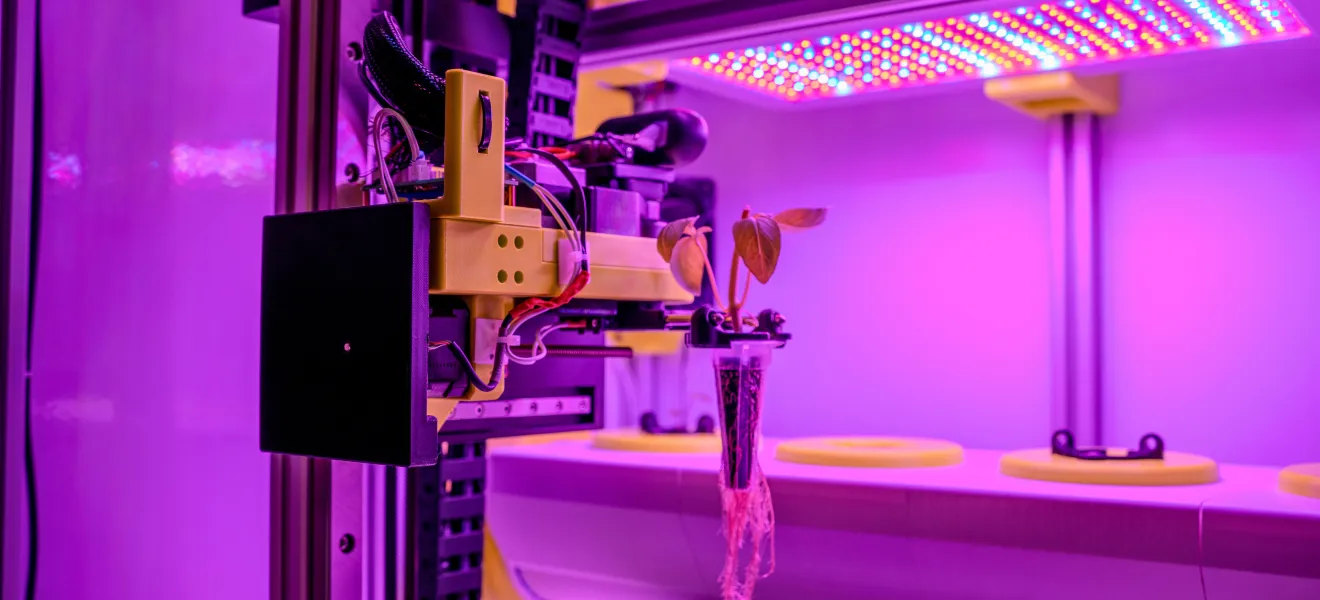
A plant in the early growing stages (Photo by Grace Arena)
If a basil plant takes 100 days to mature, does that mean it's a quarter of the way there on day 25? Not necessarily.
Counting days only gives you a guess, according to a team of Wentworth Institute of Technology students who wanted a way to measure a plant's true progress, similar to the growth bars on crops in games like FarmVille and Hay Day. Their idea became Plant Wizard, a refrigerator-sized vertical farm that waters, feeds, and monitors its own crops. Five students from three Wentworth schools built it as their capstone project.
"It started as a data science project," said Electromechanical Engineering student Joshua Hofer. "We wanted to track the health of a plant. It was kind of inspired by video games."
He and his teammates wondered if they could use environmental conditions, nutrient dosing, sensor data, and computer vision to measure growth instead of simply estimating it.
Electromechanical Engineering students Kannon Behrens, Jeffrey Caldwell, and Hofer, all Class of 2026, along with Cybersecurity student Tyler Ricketts '27, built that platform starting in January. Business Management student Grace Arena ’26 joined as project manager in the summer semester.
The finished machine looks like a cross between a refrigerator and a vending machine. The frame is custom aluminum, cut to length, and the interior contains a robotic gantry, a hydroponic growing system, and a bank of sensors that track humidity, temperature, and water levels. Most of the components were 3D-printed.
"All they need to do is insert a seed into a seed pod, place it in, and just make sure they top the water off once every month," Caldwell said. "This robot will automatically inspect each plant. It'll move seedlings to the full hydroponics area when it's ready and do all the maintenance that a user would usually spend hours doing."
The system doses nutrients, keeps each grow chamber watered, and changes its lighting as plants move through each stage of growth. A custom app, designed like a game, lets users check on their plants and sends a notification when new seedlings are ready to move.
The goal is to make growing food as easy as possible.
"A lot of people don't have gardens, they don't have places to grow, they don't have the time, they don't have the skills," said Behrens. "This kind of gives people an entry level."
Arena represents the kind of user the team hopes to reach. "I have whatever the opposite of a green thumb is," she said. "I have killed every plant I've tried to grow." With Plant Wizard, she added, "the artificial intelligence and the robot do all the work for you. And you can adjust it to make it as hands-on as you like."
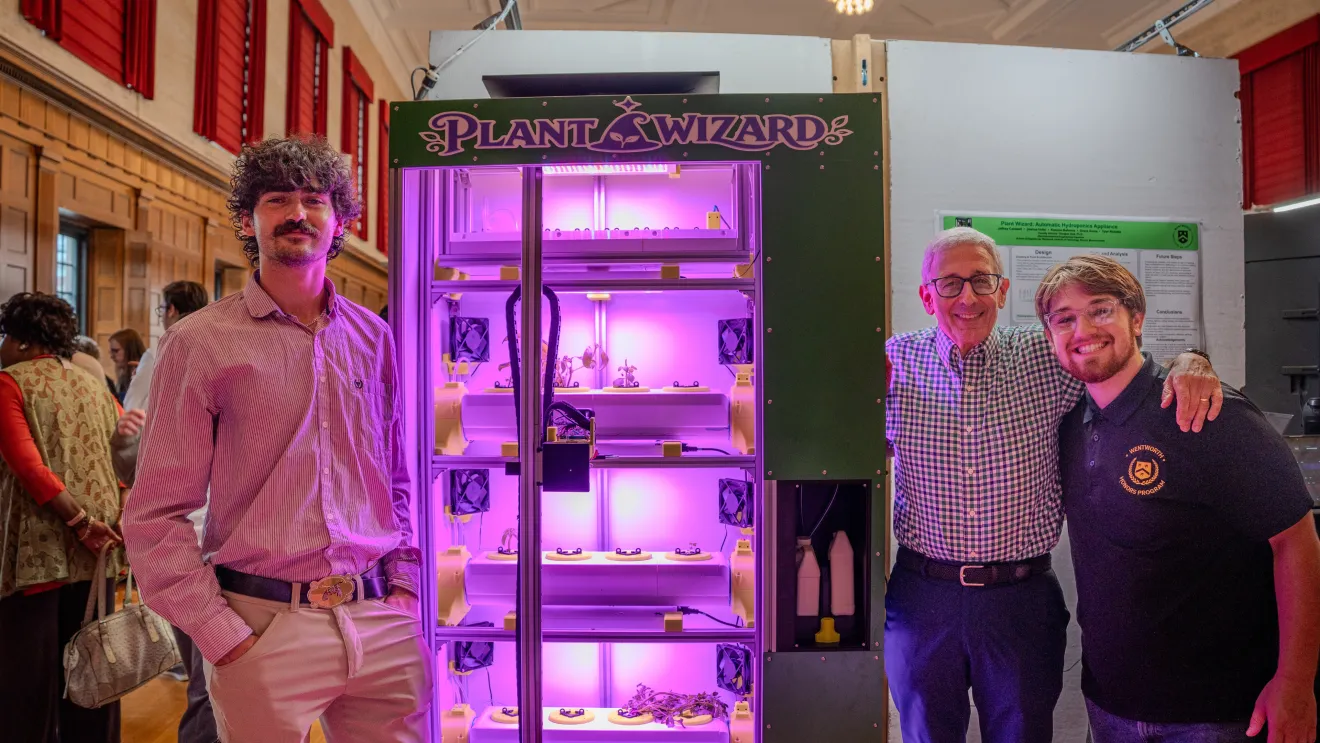
Plant Wizard was a joint capstone between schools, organized with help from School of Management Professor Michael Mozill and School of Engineering Professor Douglas Dow. Arena, who concentrates in Project Management, took responsibility for coordinating the team. She organized weekly meetings, agile sprints, and standups, tracking the schedule in Microsoft Project before moving the work into Jira. She also held regular one-on-ones with each engineer and monitored the budget against actual costs.
"I learned so much from them on their process and about what other disciplines look like," Arena said. "Just seeing them build this was amazing. They put hours and hours of hard work into it, fueled by tons of caffeine and determination and passion for their work."
She also wrote a business plan, including one idea for a smaller build-it-yourself kit that could be used in elementary and middle school classrooms. "We thought it would be really interesting to encourage more kids to go into engineering," she said, "and get kids thinking about what they want to do and what they enjoy, and working with their hands."
Hofer believes the range of skills on the team is what made it work. "It brought together mechanical engineering, electrical engineering, embedded systems, controls, software development, manufacturing, and data science into one integrated system," he said. "Every member of our team approached the project from a different perspective, and that collaboration is what made it successful."
For the team, their prototype is simply a starting point.
"Once we figure out how to grow the plants and how to control all these different subsystems together to make it work, then we can go back and make it smaller, make it more efficient, more modular," said Behrens.
Every sensor reading, nutrient adjustment, and image the machine collects adds to the dataset behind the original basil question. "Our long-term vision is to use artificial intelligence to estimate a plant's health almost like a progress or health bar in a video game," Hofer said, "while identifying stress, nutrient deficiencies, and optimal harvest timing before they become obvious to the human eye."
The idea is to fit fresh food into a busy life.
"Functional but fun," Hofer said. "So somebody like a busy engineer can grow plants without having to spend all their time tending to them.”
As the team likes to put it, “Grow Strong, Stay Wizard.”