
Wentworth Under 30: How Alumni are Trashing the Old Recycling Playbook with 'Scrapp'
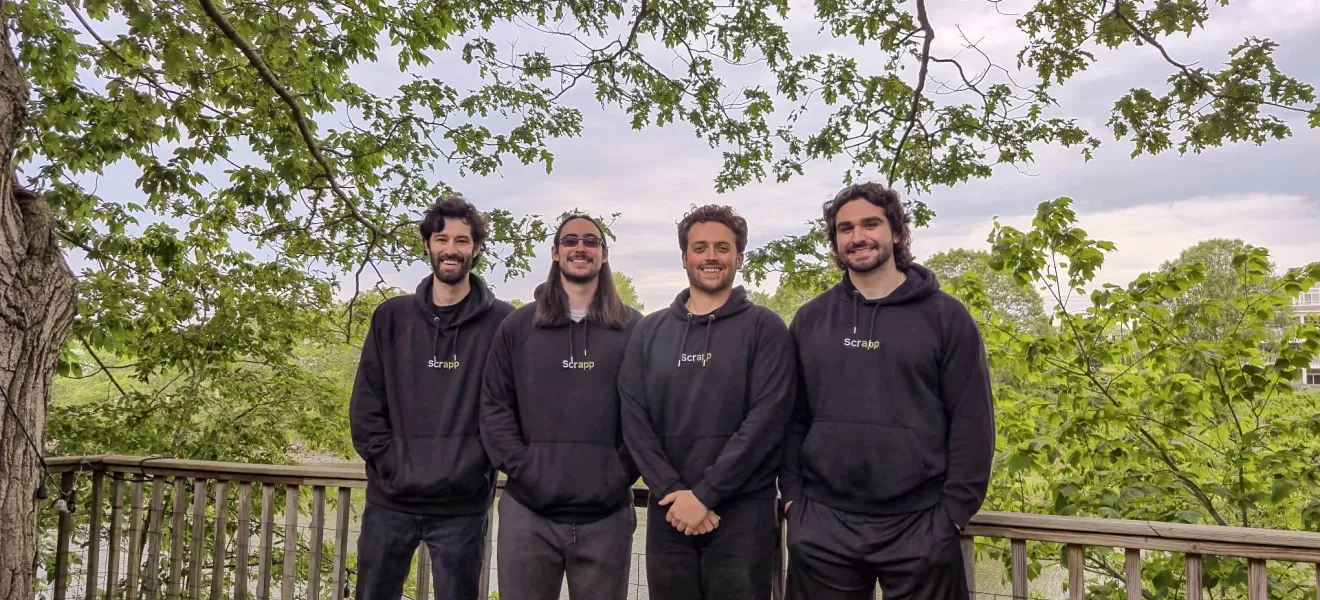
From left: Thomas R. Evangelista (CTO), John Scarfo (CIO), Evan Gwynne Davies (CEO), Mikey Pasciuto (CSO)
Wentworth Under 30: They are entrepreneurs, innovators, and leaders—and they are just getting started. In this new ongoing series, we highlight exceptional alumni under the age of 30 who are redefining what is possible in their fields. Representing every school at the university, these graduates prove that age is no barrier to making a global impact.
For Thomas Evangelista and John Scarfo, the journey to building a global sustainability tech company did not begin in a corporate boardroom. It began in a Calculus I classroom at Wentworth Institute of Technology.
Today, the two Computer Science graduates serve as Scrapp’s Chief Technology Officer and Chief Information Officer. The company is focused on a stubborn problem in recycling and waste disposal: contamination, and the environmental and logistical problems that come with it.
From Classmates to Co-Founders
Evangelista and Scarfo met in Calculus I, but they really became friends in Computer Science II after teaming up for a class project. They made the decision after that to sync their schedules and stay in the same classes whenever they could.
As Evangelista puts it, they “stuck together for the rest of our time at Wentworth.”
They enjoyed working together, and the friend group around them shared the same interests of entrepreneurship, building things, and doing more than what class required.
Both added minors in Applied Math and Entrepreneurship alongside their Computer Science degrees. That meant overloaded semesters, extra math and business classes, and a pace that felt a lot like startup life.
Scarfo now sees that stretch as formative.
“Putting ourselves in this situation proved to be exactly what we needed,” he said. “It built up our capacity to work and significantly assisted us in the development of Scrapp.”
Before Scrapp, the two were already trying to build things together. One early effort (events software they started developing with another friend) was derailed by the COVID-19 pandemic. But the experience taught them how quickly a project can change and how important it is to adapt.
After graduation, their paths split briefly. Evangelista stayed at Wentworth to earn a master’s degree in Project Management, while Scarfo went to work at Eaton Vance, where he had already completed co-ops.
Turning an Idea into a Product
The original concept for Scrapp came from outside Wentworth. A group at the University of New Hampshire developed an idea for self-sorting recycling bins through sustainability-focused coursework. After a year of market research and several pivots, that team realized the better opportunity was an app, but they did not yet have the technical founders needed to build it.
Through a high school connection, the UNH group reached out to Scarfo. He brought Evangelista into the conversation, and the two quickly saw an opportunity. They officially joined the team and helped turn the idea into a real product.
From the beginning, the problem was clear: recycling contamination. When non-recyclables end up in the recycling stream, the effects ripple outward. There are higher processing costs, increased waste, lower trust in the system, and recyclable material that ends up being discarded.
The team’s early goal was to build a free educational tool that could help reduce contamination in a meaningful way. At first, the business model was still taking shape. But as the product evolved, so did the strategy.
“Looking at now,” Evangelista said, “as we kept refining the system, we found a lot of synergies and the path became clearer and clearer with every improvement and every adjustment to the model.”
The earliest version of Scrapp was intentionally simple. But as the team spoke with brands, municipalities, haulers, packaging stakeholders, and others across the waste system, they realized the real challenge was not just adding features. They wanted to rebuild the core system so it could do the job well.
“There is no single piece of feedback alone that changed the direction,” Evangelista said. “But the biggest decision we made that enabled us to build the system we have now was our commitment to ensuring that our system was geographical in the sense that it could support localized guidance, but granular enough in our type system for packaging that we could classify items from across the globe into one system.”
In other words, the product could not stop at telling users whether something was recyclable in general. It had to be local, specific, and detailed enough to work at scale.
Since those early versions, Scrapp has grown into a platform designed to make recycling and other disposal information more useful for both users and organizations.
In recent months, the team has worked on real-time translation, expanded municipal bin-day reminder tools, and added new features requested by current clients. They are now building more administrative tools into the customer web portal, giving clients more direct control over how the platform works in their communities.
As CIO, Scarfo oversees Scrapp’s database systems and the AI work tied to data ingestion and processing.
The Wentworth Foundation
Both alumni say Wentworth gave them practical tools and a mindset that fit the demands of startup life.
For Scarfo, that foundation started with a database course taught by Professor Hongsheng Wu, which sparked his interest in SQL and data. He built upon that through an optional summer co-op after sophomore year at Eagle Investment Systems, a BNY Mellon company, where he created dashboard visualizations and analyzed log data to find insights and opportunities for improvement.
That experience paid off again later. When he landed a co-op at Eaton Vance, his direct manager had also worked at Eagle, helping open the door. At Eaton Vance, Scarfo became a go-to resource for data visualization and SQL function validation, and he eventually completed both of his required co-ops there.
A big data course he took during COVID also translated directly to his work at Scrapp, especially when handling large volumes of client data such as yearlong hauler records or full municipal trash and recycling schedules.
“Wentworth gave me the tools to find an avenue and work with it,” Scarfo said. “I was never the best at coding, but when it came to databases and data, I excelled and Wentworth allowed me to hone that passion.”
For Evangelista, the university's flexibility was just as important. While studying abroad in Germany, he and Scarfo wanted to learn mobile development through Dart and Flutter. Through an independent study, and with support from Professor Memo Ergezer, they pitched and built a mobile app development course from scratch. It became an early version of the kind of work they would later do at Scrapp: reading documentation, building MVPs (most viable products), iterating, and shipping.
Evangelista shares that his master’s degree in Project Management became especially valuable once Scrapp evolved into a fully remote, global company. At one point, the technical team spanned five time zones, from Colorado to Singapore. Managing contractors and coordinating across projects required structure and communication.
Building with People
For both founders, Wentworth reinforced the value of finding people you work well with and building together.
“Starting is hard,” Evangelista said. “But when I'm in a group and we're all working toward something together, it can be so much more exciting.”
His advice to current Wentworth students is to find something that interests you—or find people you work well with who are excited about something—and start building.
“Find people from classes you work well with,” Evangelista said, “and then work on it together.”
***
Read more from the Wentworth Under 30 series: