
Fariba Khoshnasib-Zeinabad
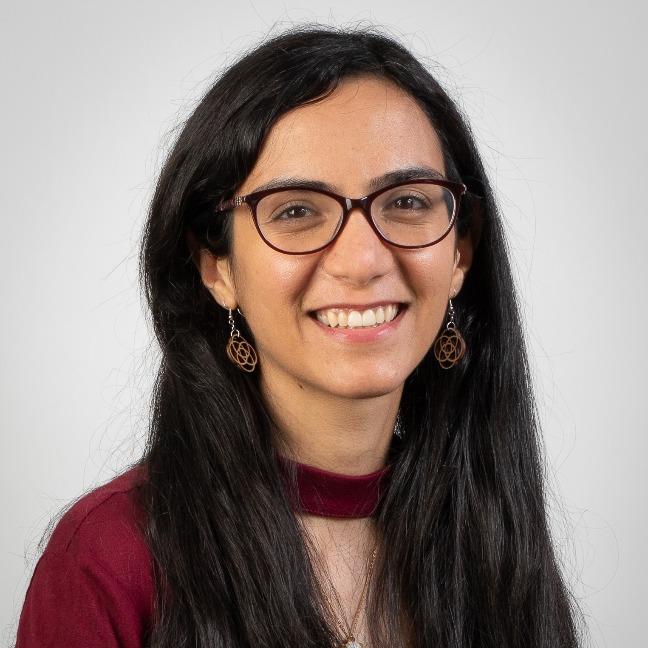
Bio
Fariba completed her Doctor of Philosophy (Ph.D.) in Mathematics at The University of Texas at Dallas, where her research and teaching experiences laid a strong foundation in mathematical theory, quantitative analysis, and academic instruction. Prior to joining WIT, she served as a Visiting Assistant Professor at Earlham College and University of Wisconsin-Eau Claire, and has held multiple academic roles supporting students across mathematics and data science disciplines.
A passionate educator, Fariba’s commitment extends beyond the classroom. She has played leadership roles in academic effectiveness and curriculum development, including serving as Co-Director of Institutional Effectiveness at Earlham College, and has supported student success through tutoring, instruction, and research mentoring.
Her work also engages the broader mathematical community. In 2025, she served as Project Director for “Puzzles, Pi, and Pathways to Mathematics,” a Tensor Foundation outreach initiative designed to inspire and empower female and underrepresented students through immersive math-enrichment experiences.
Education
Accomplishments
MAA Tensor Women and Mathematics Grant Awardee (2025) – $5,935 outreach grant supporting women in mathematics at Wentworth Institute of Technology.
Lois Ascher Award (2023) – Wentworth Institute of Technology.
$20,000 GLCA Sustainability Modeling Grant (2018) – Interdisciplinary modeling research collaboration between Earlham College and DePauw University.
$5,000 Summer Research Grant (2021) – Supervised student research on economic recovery index modeling at Earlham College
Research Interests
Dr. Fariba Khoshnasib-Zeinabad’s research lies at the intersection of data analysis, applied mathematics, and real-world modeling. Her work integrates theoretical mathematical frameworks with modern computational tools to better understand complex systems and inform decision-making.
Her interests in regression analysis and statistical modeling focus on extracting meaningful structure from data, particularly in economic, social, and interdisciplinary contexts. She is interested in both classical and modern regression techniques, model selection, interpretability, and the responsible use of data in policy and business applications.
In differential equations and dynamical systems, she studies how mathematical structures describe evolving phenomena over time. Her interests include stability analysis, qualitative behavior of nonlinear systems, and the translation of theoretical results into computational simulations. She is particularly drawn to modeling systems where small changes in parameters lead to significant shifts in long-term behavior.
Through mathematical modeling, she explores how abstract mathematics can address applied problems in economics, public policy, and interdisciplinary STEM fields. Her approach emphasizes clarity, rigor, and accessibility—often engaging undergraduate researchers in applied projects that connect theory, computation, and real-world impact.
Across all areas, her research philosophy centers on bridging theory and application, fostering undergraduate research, and promoting inclusive participation in quantitative fields.